Showing posts with label twitter. Show all posts

Tuesday, 25 July 2017

S**tposting: Facebook's anarchic meme playgrounds

The internet is, essentially, a horrible place. The last great frontier of humanity - the deeps of the ocean, of space, of other worlds and dimensions can all be traversed - and probably will - by highly trained professionals.Conversely, the internet can be accessed by anyone with an internet connection and requires no training at all. It's all but ungovernable, with only the strangest of government legislation, like the Investigatory Powers bill, that will permit the Security Service to flick though your sexts in the name of protecting freedom. It's a churning well of bizarre cultural mashups, beyond-the-curve trends, sexual disinformation, unfiltered violence and microtransaction mobile games.

The bizarre meme-size mashups of the Left.
And of course, the memes. The often surreal graphical snapshots that convey an often extreme concept in a crudely enhanced manner. They were suddenly potent weapons deployed in the high level political skirmishes of 16-17, a conduit from the crazed fringes of the internet right to the heart of mainstream culture. We're suddenly up to our shoulders in incomprehensible mutated comedy, a world where the Right Honorable Jacob William Rees-Mogg, the stereotypical Home Counties Tory's stereotypical Home Counties Tory, has his own #Moggmentum, a meme-producing teen online machine.

It is Facebook, ironically enough, that is the great incubator for this insanity. Zuckerberg's advertising hothouse, where your parents learn about emojis and share incoherent hatred from MailOnline and the Daily Express, doesn't immediately strike you as the oven for half-baked political ideology masquerading as a poorly-drawn smirking frog. But it's that huge audience set up with sharing tools that enables chain-reaction content to launch itself halfway around the world, whilst 4chan squats solitary at the bottom of the barrel and Reddit is left eating its own tail. Even Twitter, at times feeling like a tap on an ocean of ill-informed and badly-spelled hatred, still has some internal braking system, its very architecture allowing forces to marshal rapidly and as a group boost a signal or beat down a message.

Not so with Facebook, the central nervous system of the 'normies', the vast crowd of humanity for whom life isn't actually a quest for OC and screaming at strangers in another country at four in the morning. Yet it is so very easy to fall into that world, and nowhere are the barriers between one reality and the next thinner than in Shitposting groups.

There's one for every conceivable entertainment project, from Star Wars Sithposting to The Office (US) to America's first family, The Simpsons. To step into one is to enter a crass and crude hall of mirrors, with every reflection an incomprehensible distortion of some vaguely familiar joke. Memes whirl, collide, mutate and recycle in a never-ending merry-go-round with updates several times an hour, constantly as members from around the world log on to post updates, bicker, insult, fight, block and post memes at each other. Rock Bottom is another Simpsons group and they have a contentious relationship with their bigger brother - users are accused of 'spies', battle lines are drawn, and the ban hammer often descends from the heavens.

This refers to admins in Rock Bottom.
Who indeed would play ringmaster in one of these insane circuses of awkward adolescent amusement? The Admins in shitposting fall into one of two groups I feel, silent masterminds who either police their fiefdoms with draconian severity... or public spectacles who become one with the meme machine, the strangest of all mutations in a world where comedy is measured by the obscurity and subsequent random alterations a joke, character, scene or phrase can go through.

They no longer make the memes, they are the memes. With hundreds of thousands of fans packing out each and every community this weird wave continues to rise and may never crest, for as long as Facebook - with its own inability to   police itself properly - allows them their voice, they will continue to shrill at the top of their surreal voices. This is the generation that has suddenly turned out in droves for the latest general election, this is the generation that will start setting the political agenda, and this is the generation that communicates every concept through a filter - an instagram filter - of chaotic comedy.

Thursday, 7 January 2016

A Storm in a Puddle: #DrummondPuddleWatch

It's spontaneity, the elusive spark of creation that fires an insane idea right around the world, leaving professional communications and marketing professionals gnashing their teeth and turning green in envy.
So it was with #DrummondPuddleWatch, where a Newcastle-based media strategy company decided to livestream the efforts of commuters to navigate a large puddle outside their offices.


The internet latched on with all its explosive and unpredictable enthusiasm. By the time twenty thousand people were streaming the feed through Periscope, it attracted the attention of the press and social media.
Between them, they magnified the experience - more and more people signed in to see what the deal was. Chain reaction, triggering ever more social media posts exclaiming surprise and confusion (like shock and awe, but less dangerous), ever more media coverage, and ever more visitors to the feed.

I have a few theories about the success of the Drummond Puddle. I think I spoke to the intrinsic nature of the British, an entire nation fixated on our temperamental weather system, especially after the rigorous storms and destructive flooding recently.
Note also the popularity of memes when snowfall disrupts the British transport system so effectively each time; if any nation on the world can cope with heavy rainfall, surely it should be Britain!

Ultimately, it typifies that British stereotype of reservation, fussiness, our passion for the passionless. "So British!" came the cry again and again, across every social media channel as they observed our endless battle with the slightly annoying elements of a few more inches extra rain.


The company at the heart of it all, Drummond Central, insisted to the world's media they weren't in fact staging a massive PR coup. I believe them - they were coy via their own social media channels, retweeting the best bits only.
Not so every other major band, latching onto the passing coattails and ultimately dragging the Emperor's New Clothes down in the muddy puddles. Mashable posted a great digest of some shameless cashing in from huge brands that, many claim, were second only to the spambots for ruining a good hashtag!

Yet that is their job - or, more accurately, their job is to somehow anticipate these kind of phenomena and if possible co-opt them for their clients. That can be the ultimate kiss of death to something that thrives on spontaneity - remember flash mobs? Before they were used in cringe-inducing adverts set in train stations?

There was no future in the Drummond Puddle of course. Well, I mean, it's still there and probably will be for some time, based on the forecasts. But the madness, the inmates running the asylum, the whole social media furore had to pass, like a storm in a muddy puddle. I was lucky enough to stop by and see the triumphant last minutes.


Afterwards, a Drummond Central employee hastily scraped some water into a bottle. "You aren't going to put it on eBay are you?" I asked wonderingly. "No," he laughed. "Just a memento from the day we broke the Internet!"

Well, Newcastle's insufficient drainage did, for a few hours anyway, achieve second-highest worldwide trending topic on Twitter and level pegging with the gleaming buttocks of a Kardashian. You can't break the internet with content like this, of course. It's the fuel the internet needs to grow, baffle, amuse, entertain and - ultimately - to advertise.

Friday, 23 January 2015

Dylan Sharpe's Ironic Justice

Like many opposed to The Sun's Page Three feature, I was part of the mad rush to dance on its' supposed grave on Wednesday. Then, when the tabloid pulled the rag out from under us all, I was smarting and bitter at their - non-existent - duplicity!
I was wrong, I'd committed a cardinal sin of journalism by making an assumption, a leap of faith without the evidence to back it up. Call it a valuable lesson, and hopefully all of the media commentators who made the same mistake will also come away wiser and more cynical.

What they didn't need is Dylan Sharpe's superior tweet to some of the most well-known journalists, as well as a sympathetic politician who sincerely hoped her campaign had made a difference.
Even Sharpe, in his apology - published on Buzzfeed oddly, not The Sun itself - acknowledges a pot-shot at Harriet Harman was unnecessary. "Guilty of gloating", he conceded.

In reality, he has done a fantastic job of Public Relations. Not only has The Sun pulled off one of the greatest bait-and-switch moves in journalism history, Sharpe has stoked the fires by taking to that great media battlefield and throwing oil on the inferno. There's no such thing as bad publicity!

I fully expect the entire operation has galvanized the legions of otherwise apathetic white van men, who feared for the loss of the morning totty, and whose brand loyalty can only improve with this swerve towards cancellation.
I expect the increased polarisation of discussion about Page Three online will keep The Sun riding high in press coverage and media discussion.
I believe that Sharpe's jibing swipe at his detractors eggs the argument on, creating a vortex of ardent conversation that this article itself is just one bubble of.

It all contributes to a major PR coup for Murdoch's flagship tabloid, back from the dead more than Vlad Dracula. What did interest me was Sharpe's closing wish...
So there it is. I continue to be told I’m a c*nt by people who know my name, my job and one tweet I sent. Guilty of gloating I most certainly am. Icarus has well and truly plummeted to earth. But I never meant to offend and I want to apologise to all those I @’ed in that tweet. It was supposed to be funny but clearly I misjudged that one. Now I see if Twitter can forgive as quickly as it can hate….
Really. A white male employee of a sexist British tabloid, asking for forgiveness from Twitter. If this isn't a delightfully ironic parallel to the entire concept of media self-regulation, of toothless press watchdogs forgiving one another their myriad sins, then I don't know what is.

I honestly can't tell if Sharpe is concealing another 'cheeky swipe' in his apology, fully acknowledging the hypocrisy of begging for mercy from Twitter for giving the MRAs and trolls exactly what they wanted. Compare his two days experience to what someone like Caroline Criado-Perez has endured for years, and try and accommodate how disingenuous it is.

Caroline's twitter feed included this retweet that I particularly like, and find very appropriate.
However, we must resist the urge to relish Sharpe's experience of mistreatment at the hands of Twitter. As tempting as it is for an evident supporter of patriarchy to suddenly be on the grim receiving end of that institution's crude online 'justice', we should not wish that punishment on anyone.

That punishment should not exist. Nobody, no-one at all should have to endure threats of harm, death, and violence online. We should condemn those who threaten Dylan Sharpe with all the fire and fervour we condemn those who threaten Criado-Perez, or Anita Sarkeesian, or Brianna Wu, or anyone else who has dared come out and state that women are treated as second-class citizens.

Nobody is a second-class citizen - and the last person who should be regarded as so is Dylan Sharpe. Even if it seems like he doesn't agree with the concept.

---

One closing thought - much of the debate about Page Three swirls around rendering the models as mere objects, objectification being a major plank of feminism, I believe. To counter that, Channel Four conducted a brilliant interview with author Germaine Greer, Harriet Harman MP, and model Chloe Goodman - you can watch it here.


I'd be curious to know what Nicole, 22 from Bournemouth thinks about the debate swirling around her decision - and it is hers - to appear on Page Three.

Monday, 24 February 2014

Journalism Week 2014 and Harold Ramis

Rather than an in-depth article, which I am intending, I just wanted to update today with a few succinct points to keep my hand in the blogging field.


It is the 2014 Journalism Week at Leeds Trinity University, the alma mater and the first in three years that I haven't been able to attend. Thankfully, it can all be followed on twitter via the #ltjw hashtag, and following @JournalismWeek, and reading the official blog of the post-grad team, and watch it live, and...

Well, suffice to say I am very envious of those attending. It was one of the motivating factors behind Leeds Eye View, and you can read my multimedia updates from previous Journalism Weeks in my archives.

One of the articles I've most appreciated coming out of #ltjw 2014 has been by post-graduate lecturer Richard Horsman, and it's a wry lesson for the exuberant, ever-connected generation. I hope some of the student hacks at Trinity take this lesson to heart!

When I saw it pop up on Twitter, I was inspired to comment to him as below:
Much of the hue and cry about the 'death' of old Journalism and the rise of the blogger has since subsided in the face of, dare I say it, common sense. The call is not for old-fashioned trained journalists to be replaced by the smartphone and wifi - but for the journalist to add those tools to their armoury!

T-T-T-T-T-T-T-T-T-T-T-T-T-T-T-T-T-T-T-T

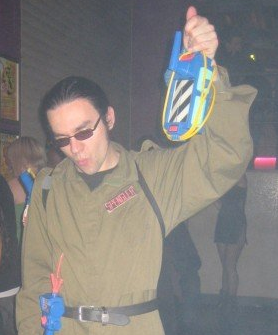
 On a more sombre note, today American actor, director and producer Harold Ramis has died, aged just 69. Like many British kids who are proud nerds, I grew up watching Ghostbusters over and over and over again. Ramis' potrayal of the awkward, brilliant, and surprisingly sly Dr Egon Spengler was to me how footballers or pop stars must appeal to the regular, sporty, confident kids. 
Still a favourite fancy dress outfit!
Spengler was a hero, a goal to aim for - if perhaps a little less nebbish - and proof that having brains was not an obstacle to becoming popular and achieving goals. The man saved the world!

He helped me feel more at ease with myself during adolescence, instilled in me a love of intelligence for knowledge's sake, and an appreciation for a dry, deadpan delivery. I am not surprised to read the list of contemporary, feted directors and producers who cite Ramis' quiet work behind some of the classic Eighties comedies as such a great influence.
Ramis' comedies were often wild, silly and tilting toward anarchy, but they also were cerebral and iconoclastic, with the filmmaker heeding the Second City edict to work at the top of one's intelligence. This combination of smart and gut-bustingly funny led a generation of comedic actors and filmmakers — including Judd Apatow, Peter Farrelly, Jake Kasdan, and Adam Sandler — to cite him as a key inspiration.
That's a legacy any Hollywood veteran can be proud of. I was grateful for an awesome character in a brilliant comedy that will undoubtedly stand the test of time. My thoughts are with Ramis' nearest and dearest, as well as fans around the world.

Courtesy of Ghostbusters Wiki

Thursday, 28 February 2013

Journalism Week 2013 - Neil Wallis, former Executive Editor of the News of the World

Possibly one of the most highly anticipated speakers at Journalism Week was Neil Wallis, lauded in our programme as a former editor of The People, Executive Editor of the News of the World, and member of the Press Complaints Commission.

He was one of many journalists arrested following the phone-hacking scandal in 2011 on charges of conspiracy to intercept mobile communications. Just recently the Crown Prosecution Service dropped their case against him, citing a lack of evidence to secure a conviction.

If there is a man more qualified or able to talk to us about the journalism industry and the Leveson proposals, then we haven't met them yet! Certainly, the tone was set before he even began with his presentation entitled "LEVESON: Devil in the Detail - Why Inquiry Report Threatens Press Freedom In More Ways Than One". Quite clear what his feelings on the reforms of the media are!

Neil was introduced by his former employee, and current Leeds Trinity Senior Lecturer in Media Law - appropriately enough! - Nigel Green. It was a perfect moment for Neil's phone to ring, and one wag in the audience (I have my suspicions about who!) shouted "It's Leveson!" to laughter all round.

Turning then to the serious, Neil was candid about his arrest, his bail and his subsequent exoneration - "It's scary. You feel like wetting yourself! It brings everything to a grinding halt - your life, your family, your career." The mood of the room was actually sympathetic, and it will be interesting to see if that holds up tomorrow when we're joined by Professor Brian Cathcart of the Hacked Off campaign, bitter ideological opponents to Mr Wallis and co.

Back to today, and Neil - cleared of all charges - has now set his sights on those arguing for the toughest of press reforms as proposed by the Leveson Inquiry. He painted a very convincing picture of the dangers of appointing a statutory regulator - specifically one backed by (and therefore dominated by) Parliament.

A Parliament, of course, that is wracked by scandal, corruption and ineptitude - see left!
There has been no end to the procession of crimes and misdemeanours of our elected leaders - exposed, naturally, by the Press they're now struggling to gag.

Hitting the topical angle, Neil referred to the Rennard scandal engulfing Nick Clegg's Lib-Dems, and how it was broken by a Journalist, those self-appointed detectives that the Deputy Prime Minister has made inadvisable enemies of!

Picture courtesy of @DMJHull


He spoke rousingly and charmed an audience of - I'll be honest - naieve journalism students who have been raised on a diet of cynicism towards the Government, even though their (our?) faith is still in the Guardian and the ethical correctness of the Leveson Inquiry. Nonetheless, it's clear to see how he was able to wield such influence over a Murdoch newsroom - and we're only seeing the beauty of charm and not the 'Wolfman' beast!

When the Q&A came around after a very quick half-hour, Neil made it clear how he'd tackle press reform. Trinity Journalism Graduate, and next Paxman Ben Cropper asked him if the Press Complaints Commission - of which Neil had sat on the board as a tabloid Editor - was a "toothless watchdog".
Neil responded forcefully that the PCC simply lacked stronger investigative powers - which seems surprising as the main complaint against the PCC seemed to be its lack of punitive strength instead. As an editor, however, Neil stated how he spoke to the PCC practically every day, checking the suitability of his stories - and is that a comment on other editors who might not have held to that admirable practice? He made it clear that "People were not arrested becase they broke the Editors Code of Conduct - they broke the law. The PCC couldn't stand in the way of that."


At one point he turned the entire Q&A on its head and asked us at one point we'd fall back on that tried and tested method of chequebook journalism. I couldn't tell if the silence that greeted him was moral in fibre, or just squirming! A few hardy souls ventured to admit they'd pay out for stories, and uppermost in my mind was securing the Telegraph scoop on the Expenses scandal. It was an interesting moral conundrum, and he continued the theme when asked if there was indeed a culture of criminality amongst the tabloids - "No, but I know a lot of journalists who sail bloody close to the wind!"

It's fair to say Journalism has always operated in the 'grey' areas, both morally and legally - indeed, it's probably where it's most needed. I had decided long before this session to get into this as far as possible, and tweeted a former Journalism Week guest - infamous tabloid apostate Richard Peppiatt. 


I asked Richard what I should specifically put to Neil, considering their naturally opposing viewpoints on a common topic. By the wonders of modern technology, the link to the right will show you all of Neil's talk and at 43:35 I am the person who asks the question - "Regarding press freedom, which you have discussed extensively and proudly, how do you reconcile it with the fact that all 175 titles owned by Murdoch simultaneously supported the Iraq War?"

The response I get is somewhat confusing - not certain that I would describe Rupert Murdoch's work as "left-of-centre papers". Nor would I describe all of his titles as "not being huge opinion formers." And his decision to mention the 'Editor of the Times' as opposing proprietorial influence seems laughably inappropriate!

Raising the most eyebrows, of course, is Neil's vehement response to Mr Peppiatt which came across as a violet drubbing. No less energetic is his attack moments later on Professor Cathcart, but Richard himself has already been responding to the comments via Twitter and the Journalism Week hashtag #ltjw until just recently, several hours after the talk has concluded!

Will the Hacked Off campaign respond equally forcefully to this tabloid supremo turned press freedom fighter? No doubt there will be even more exciting developments as Journalism Week comes to an end for another year, continuing the theme whereby I ask impertinent questions of important people!

Until tomorrow...!


Tuesday, 8 January 2013

Leeds Trinity 2013: Gabby Logan, Chancellor

A Happy New Year to all the readers of Leeds Eye View!

As you know, I am a Journalism student at Leeds Trinity University - which proudly received that final recognition of University title in December of last year. Not content with just that major transformation, the University has today announced that Leeds-born, award-winning sports presenter Gabby Logan has become the new Chancellor!

And of course, when you have industry-grade facilities at hand, you make an announcement in your own style! So after a formal introduction to staff, governors, students and press, Gabby came to our modern new TV studio facilities - which I have recently put to use myself - to be interviewed by students from the Centre for Journalism! Indeed, she was unique amongst guests in that she could teach us a great deal about the challenges of television presenting.

Of course we weren't the only ones with a nose for the story, and press from Calendar, Look North and the Yorkshire Post were all jostling for room inside our facilities. Indeed, at one point I had those two titans of regional broadcasting - Harry Gration and Duncan Wood - sat directly behind me as I engineered the sound for our programme. This was not the time for me to hit the wrong button on our music console, but indeed I did so. An anecdote to laugh over in the future, but one to cringe about now!

Such fears were not troubling Gabby however, as she spoke enthusiastically to Sammy Parker about embracing the role, and hoping she could inspire students to gain the most from a University degree - something she states definitely benefited her career. Afterwards, she chatted with Duncan and Harry, reminiscing about their pasts - as Gabby had come up in reporting via work experience with none other than Mr Gration, the beloved face of Look North!

Again, she was able to show how her own professional experiences, backed up by her own treasured University days, would be such an immense boon to Leeds Trinity, in the town to which she has strong ties.

Once the video interviews were concluded, Gabby and the crew of the studio, who were almost all bright new journalists on Trinity degrees, were snapped in glowing photoshoots. At the same time, I was able to talk with Professor Margaret House, the University Vice-Chancellor who joined us just prior to Gabby's announcement. I was able to keep Professor House up to date with the Twitter storm we were all generating - causing trending to occur within minutes - and in turn hope I satisfactorily answered her searching questions about being a student at Trinity. I'm a Student Rep and I discuss University matters with staff frequently, but even I was gratified at this level of interest in, and engagement with, students on their level.

After this, Gabby was again whisked away, this time to the modern radio broadcast facilities in the Centre for Journalism where she conducted interviews with BBC Radio Leeds, Pulse Radio, and Radio Aire, all with the assistance of award-winning post-grad lecturer Richard Horsman. Here she acknowledged the uniqueness of Professor House and herself leading the way in academia, a hot topic in higher education circles - and she stated how old-fashioned views of 'traditional' roles for men and women should be challenged.

It's another encouraging sign from someone who will become an Ambassador for the University, and a role model for many aspiring students, especially based on the reactions of those she passed on campus! So a day of media engagements was drawn to a close, and we lucky journalists who covered it are now submitting our stories.

Gabby Logan is the new Chancellor of the new Leeds Trinity University, in the New Year of 2013. It's an exciting time to be part of it!


Friday, 30 November 2012

Has Leveson Logged Off?

The blogosphere is unsurprisingly swamped with responses to the publication of the report from the Leveson Inquiry - that Sword of Damocles suspended over the head of British media. 

Or, more accurately, the PRINT media. 'Dead Tree' journalism as it is routinely and scornfully referred to by disciples of the other mediums of communication - yes, even in this so-called 'multiplatform' age. The divides between television, internet, radio and broadcast journalism have never been more keenly felt than when the knives came out for the pariahs of Wapping and Fleet Street. 


Indeed, many commentators - such as the Wannabe Hacks - have observed Lord Justice Leveson's failure to include the quasi-press entities online in his recommendations to the government for media regulation. George Berridge of WH expressed his surprise thus:
True, the inquiry was set up to look at the print press but, Hell, when we’re spending £5m why not at least try and cover the web?
There are two responses to this. Firstly, web journalism - blogging, tweeting and social media reporting - was simply not on the stand. The catalyst for this Inquiry was the scandal exploding out of the News of the World, illuminating dodgy practices across News International even as the editors and executives desperately tried to bail out the dirty water.
At fault were some of the flagship titles of the British print media, which still remain the greatest source of news for consumers, which can influence government policy and practice (never the same thing), and which have become traditional institutions which command respect far and above the sort of work that, say, Guido Fawkes does. 


This isn't to condemn Paul Staines and his work, which certainly has its place. Indeed, he was a witness at the Inquiry, but his input was of a sideline commentator, describing the action as it happened on the field Leveson was judging - that of newspaper journalism. 
Staines wasn't being accused of hacking voicemails, blagging personal details, or any of the crimes laid at the Murdoch's door. So - for the moment, anyway - online journalism simply doesn't deserve the Leveson gunsights training on it. 

Secondly - the attitude of 'try and cover the web', with the remnants of the £5m spent on Leveson pursuing the world-famous publications which led to a 2,000 page report, indicates a dangerously optimistic opinion of success. Or a dangerously simplistic idea of how the internet actually works. 

To try and tackle the concept of legislating, even trying to control and corral the vast, chattering, rambling masses of online news producers, will be a herculean task. I cannot even imagine where to begin with such a task - but if it is to succeed, it will signal a landmark legal, cultural and social turning point in our online history. 

The internet is a vast, vital, lawless, perplexing, intimidating and invaluable place. Deciding how we proceed in this entirely new world is not something to be tacked on carelessly to the side of an equally crucial Inquiry into 'dead tree' journalism - which as we've established, is far from being woodchipped just yet. 

Let us concentrate for now on how best to regulate print media, how to put the old house in order, before we even consider the challenge of controlling the new.

Friday, 9 March 2012

Leeds Trinity Journalism Week - Conclusion

Well, #ltjw wrapped up last Thursday, and immediately after I fell foul of some horrible stomach complimant that briefly resembled appendicitis enough to alarm my GP. I hope no-one else leaving the week-long conference suffered as much as I did over that following weekend and into the next week. Typically of course, I promptly caught a cold directly after so this is the first chance I've had to drag myself back to the work left undone since then!

Firstly, you can follow this link to read my liveblog from a talk given by Richard Peppiatt, former Daily Star reporter and tabloid factotum. A recording of his lecture can be found on youtube and you'll be able to navigate to entire talks given by other speakers from the @JournoWeekLIVE account.


So the accounts of what took place are widespread and easily accessed. What were the impressions we took away from this remarkable lineup of journalistic commentators and contributors?
In short, nothing is more valuable in the current media climate than experience. Many of us had just returned from a six-week foray into the professional world as placement students - I've referred to some of the work I did at regional paper the Yorkshire Evening Post. The repeated message from our speakers was to go further, and grab every chance to create content that will give you skills and experience.

Social media was of course touted as the platform of choice, especially in an entertaining and eye-opening lecture on mobile device-enabled journalism by Chris Payne, better known as @documentally on twitter. The future of more traditional media was reassured by BBCbigwig Mark Easton, who sees established broadcast journalists as gatekeepers of hard facts in a world of information overload, but even he said "if you aren't blogging and tweeting, what are you doing?"

We touched many times on the implications of the Leveson Inquiry, including a very frank talk from former News of the World journalist and current freelancer Chris Tate. He took the surprising position of defending the fallen paper, currently at the heart of the some of the worst excesses in tabloid reporting and unethical collaboration with the authorities. From his point of view, the NoTW had a mission to hold the powerful to account in a country with a notoriously weak system of checks and balances. Whether or not it achieved that goal will be decided by the Inquiry.

I put some of Chris' opinions to notable tabloid apostate Richard Peppiatt in his discussion with us towards the end of the week, as linked above. In a balanced response, Richard acknowledged the work the NoTW achieved working with individuals who had suffered and used media exposure to benefit their campaigns - but cautioned us against forgetting the many more who wanted no contact from the vulture-like circling of 'hacks', citing examples such as Chris Jefferies, pilloried by the media after briefly being suspected in the Jo Yeates murder.

As well as where journalism can end up, we discussed in great detail where it can start, and concluded that it can start anywhere, at any time! For Dave Simpson, long-standing Guardian music critic, he freely admits he fell into it and had no prior training. Many of the questions from students were - how important is this degree I'm spending time and money on, then?

The final Q&A, with recent graduates from the university's Centre for Journalism, addressed that question in a panel setting. The alumni explained that a qualification proves your grasp of the theory, and may attract an employer's attention, but if it can't be backed up with hard, proven experience in the real media world, it simply cannot stand on it on.

Any spare time needs to be given over to interning, volunteering, blogging and tweeting to make a name for yourself. There may be less jobs out there for prospective new journalists, our guests told us, but the editors and directors, producers - and consumers - are just as desperate to hire the new talent as ever.

Thursday, 1 March 2012

Leeds Trinity Journalism Week - Ongoing

As well as tweeting like crazy (you can follow me @timLinkinister) from #ltjw, I've also turned my hand to live blogging on the University's official blog.

You can read here my coverage of the talk from Nicola Rees, a Video Journalist from BBC Leeds, and over here is my blog on Christian Payne, a Social Media and Tech Commentator.

From twelve today I'll be liveblogging again, this time for legendary tabloid apostate Richard Pepiatt, so make sure you're monitoring the blog!

Monday, 10 October 2011

Paid-for Print Promotion

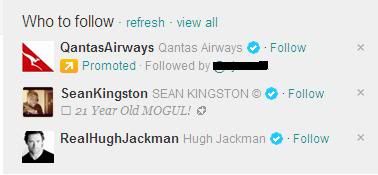
Twitter is quite transparent about when it's carrying out some corporate promotion. That little symbol beside someone I'm highly unlikely to follow suddenly turning up on my dashboard is reassuring - it's a respectable decision, and I can understand entirely their motivations, being as how they're still struggling with how to monetise this new phenomena.


At the same time, Ofcom had followed in the footsteps of American colleagues in February this year, and permitted the practice of Product Placement in British programming. The relaxation of rules was not complete; various harmful products such as weaponry, alcohol, cigarettes and - er - baby milk cannot be shown, and the placement must be within the limits of 'editorial justification', or relevancy to the show.
Many of the opposition arguments mounted fell on stony ground - traditional, conservative groups like the Church of England argued that it might 'destroy trust in broadcasters', but the appearance of Stella Artois in an episode of Eastenders rather pales in importance beside the Leveson Inquiry on a scale of betrayed consumers' indignation.


So, a prevailing attitude of tolerance towards the intermingling of media and marketing has already been displayed on television and social media. I think the time is right for print media to get on the (Bisto) gravy train, shut up the churnalism critics once and for all, and declare when they're printing PR - remembering only to ask for a slice of the promotional pie whilst they're at it, propping up those falling readership revenues.


It's already been demonstrated we can be subtle and respectful when informing consumers the content they're receiving might not be just the fevered imaginations of a soap writer, or the dull ruminations of the tweeple.
Perhaps a discreet caption above the editorial - "This Paper Supports Product Placement". Or for the more conscientious (i.e. those with the most blatant recycled PR statements) a whole new byline as illustrated?


A whole new revenue stream is just waiting to be tapped. An entire murky history of the blurred lines between marketing and journalism could be wiped away. We, the uneducated public, could have found out just what surveillance equipment the modern private investigator recommends for invading even the most protected of privacies.

Editors, act now to quell two problems with one cheque. But if you do, remember where you got the idea - you'll find my PR rates as competitive as my freelancer fees.

Thursday, 7 April 2011

Twilitics, or, the Language of Online

Has anyone named the process of creating a portmanteau between 'twitter' and another word, usually a verb? I just combined twitter and politics - and apart from feeling like a new-wave Sun-esque headline hack, I am honestly curious as the number of twitter-appended terms begins to rise.


There's no real thrust to today's post, merely that I was motivated by one of those interminable hashtag games that do the rounds on Facebook - this time initiated by the suddenly dynamic author behind @TheIPaper, twitter account for trendy supplemental i.

They'd run an excellent story by Steve Richards - available online here - where he discusses the atmosphere of hatred surrounding modern British politics. His headline was superb, a 'loathing' of politicians, and the twitterati - apologies, this will end soon - soon ran with the idea of coming up with a collective noun for our political masters.

You can view the results, and even take part, by pointing yourself towards #politicianplurals although you are up against some stiff competition, if I do say so myself.


Thursday, 6 January 2011

Be My Guardian?

In a move that will probably become a landmark event for the Blogger's Age, an anonymous Guardian columnist is leaving the direction of his so-far wayward love life in the hands of his readers.

As a struggling Journalism undergraduate my first thought was admiration of the scale of originality being displayed to snag a regular column position. Credit me for my cold-eyed professionalism anyway.
My second thought was a bizarre stab of sympathy; I've suffered myself from an unsteady path through the world of relationships. I'm only just reconciled with my long-term girlfriend, and during the challenging times I usually went on bitter, sullen retreat from the whole world.

So perhaps our unlucky friend has decided to turn his personal woes into public entertainment; not a world removed from Endemol's Big Brother format, thankfully moribund after years of increasing reminders of the poor state of, well, poor Britain.

It's not clear if the author is a journalist; as a student hack, I am beaten regularly about the head with tales of level-headed objectivity and this seems to be a step beyond the docile diarised tales of staple column-writing.


Of greater concern is the responsibility the author is shedding for himself, his happiness and – of keener observation – his partner, the inevitably renamed 'Hayley'. Either he has told her of his plan to conduct his personal relations like a social experiment, which would be the death-knell of any relationship; or he hasn't, and she's labouring under misconceptions that will either lead to their parting, or her participating in a bizarre performance co-ordinated by silly names on the Guardian website. Neither outcome hints at future stability.


More importantly, we – and he – should be aware of the impact of the internet, like some omnipotent toddler, wielding a massive influence online with an immensely inverse sense of responsibility. Should the masses vote for a break with the erstwhile Haley, what guarantee the Author will even meet another woman in time for next week's thrilling instalment? Come the anarchists of the internet, his every chance at intimacy could be thwarted for the online equivalent of the child who pulls wings off flies.

Speaking of silly names, Twitter has yet to pass judgement on this journalistic experiment. Twitter, I rather grandiosely think, represents the high-water mark of intelligence on the web, currently unfathomable to the trolls and weirdos of Facebook or Youtube. Their commentary, and crucially their disclosure of involvement in the voting, will be a telling analysis of this tiny feat of social engineering. Of even more value to the social commentators of our age, how the fickle consumers of the web decide to dictate the author's private life will be a fascinating insight into the flexible morality of the digital age. I hope to comment on both as the scenario develops...