Showing posts with label international. Show all posts

Thursday, 7 January 2016

A Storm in a Puddle: #DrummondPuddleWatch

It's spontaneity, the elusive spark of creation that fires an insane idea right around the world, leaving professional communications and marketing professionals gnashing their teeth and turning green in envy.
So it was with #DrummondPuddleWatch, where a Newcastle-based media strategy company decided to livestream the efforts of commuters to navigate a large puddle outside their offices.


The internet latched on with all its explosive and unpredictable enthusiasm. By the time twenty thousand people were streaming the feed through Periscope, it attracted the attention of the press and social media.
Between them, they magnified the experience - more and more people signed in to see what the deal was. Chain reaction, triggering ever more social media posts exclaiming surprise and confusion (like shock and awe, but less dangerous), ever more media coverage, and ever more visitors to the feed.

I have a few theories about the success of the Drummond Puddle. I think I spoke to the intrinsic nature of the British, an entire nation fixated on our temperamental weather system, especially after the rigorous storms and destructive flooding recently.
Note also the popularity of memes when snowfall disrupts the British transport system so effectively each time; if any nation on the world can cope with heavy rainfall, surely it should be Britain!

Ultimately, it typifies that British stereotype of reservation, fussiness, our passion for the passionless. "So British!" came the cry again and again, across every social media channel as they observed our endless battle with the slightly annoying elements of a few more inches extra rain.


The company at the heart of it all, Drummond Central, insisted to the world's media they weren't in fact staging a massive PR coup. I believe them - they were coy via their own social media channels, retweeting the best bits only.
Not so every other major band, latching onto the passing coattails and ultimately dragging the Emperor's New Clothes down in the muddy puddles. Mashable posted a great digest of some shameless cashing in from huge brands that, many claim, were second only to the spambots for ruining a good hashtag!

Yet that is their job - or, more accurately, their job is to somehow anticipate these kind of phenomena and if possible co-opt them for their clients. That can be the ultimate kiss of death to something that thrives on spontaneity - remember flash mobs? Before they were used in cringe-inducing adverts set in train stations?

There was no future in the Drummond Puddle of course. Well, I mean, it's still there and probably will be for some time, based on the forecasts. But the madness, the inmates running the asylum, the whole social media furore had to pass, like a storm in a muddy puddle. I was lucky enough to stop by and see the triumphant last minutes.


Afterwards, a Drummond Central employee hastily scraped some water into a bottle. "You aren't going to put it on eBay are you?" I asked wonderingly. "No," he laughed. "Just a memento from the day we broke the Internet!"

Well, Newcastle's insufficient drainage did, for a few hours anyway, achieve second-highest worldwide trending topic on Twitter and level pegging with the gleaming buttocks of a Kardashian. You can't break the internet with content like this, of course. It's the fuel the internet needs to grow, baffle, amuse, entertain and - ultimately - to advertise.

Wednesday, 7 January 2015

Armageddon Will Not Be Televised

There has been a flurry of online interest in the surfacing of the fabled 'doomsday' tape from the vaults of the Cable News Network.

Ted Turner, founder of the first dedicated news channel in the US, famously claimed on the launch of his channel in 1980, that
"We gonna go on air June 1, and we gonna stay on until the end of the world. When that time comes, we'll cover it, play 'Nearer, My God, to Thee,' and sign off."
Now, a former CNN intern has proven that this was indeed Turner's plan. Hunting through the famous news network's video archives, Michael Ballaban found the clip that is only to be played upon confirmation of the end of the world. Thankfully it isn't specified what form that confirmation will take.


Created during the 1980s, with the Cold War ever at risk of going hot, we shouldn't question the merit of creating an emergency broadcast for use in the likelihood of worldwide Armageddon. We might question the choice of music, which was rumoured to be the final song played by the band on RMS Titanic.

What is surprising is, well, the surprise this discovery is being met with. Perhaps, being British, I have a more phlegmatic attitude towards "We interrupt this broadcast...", as the BBC and the British Government's plans have long been well known. In 2005, the media was discussing recently declassified files detailing planned broadcasts should a nuclear attack on the United Kingdom be confirmed, drawn up as early as the immediate post-War period.

Such a broadcast was laconically referred to as the "four minute warning", so named for the brief period between confirmation of inbound missiles and their impact on target within England. This in fact was the maximum possible time for British-based detection systems, and it could have been even less time.
On confirmation, the Wartime Broadcasting Service would have been activated, overriding all existing BBC transmissions to inform in classical, RP tones, the grave news.

Delivered by familiar BBC Radio Four continuity announcer Peter Donaldson, part of the broadcast has been spliced, aptly enough, into the song Four Minute Warning by Radiohead. Peter also briefly discusses recording the automated warning on this clip from The Culture Show.


These painfully real-world examples are chilling, but far more people are familiar with the fictional portrayals of nuclear devastation in England. The leading example must be Threads, the BAFTA-award winning drama produced in 1984 and broadcast to record viewing numbers for the week.

Set within the northern English city of Sheffield, it explores the true reality of nuclear war on a very personal level, introducing us to characters and their lives which are unfortunately being led in the vicinity of a high-priority strike target. Below is an amateur trailer of this powerful and eye-opening show.


The following year, Threads was shown again on the fortieth anniversary of the Hiroshima and Nagasaki bombings. In conjunction was the first ever showing of The War Game, a documentary from the 1960s that had been banned by the BBC. Although they have never stated precisely why, the bleak nature of the psuedo-documentary style would no doubt have swung a great deal of opinion against the nuclear arms race.

The War Game does indeed make for disturbing viewing. To show it in the Eighties, when nuclear weapons had become even more powerful than the cruder atomic bombs of the post-War period that featured in the production, must have been even more disturbing.

Or perhaps people were numb to the dangers of nuclear warfare? Perhaps they'd become accustomed to the reality of annihilation, delivered so calmly by familiar BBC voices ever since the end of the Second World War?

This is why I regard the surprise and fascination surrounding the CNN tape with some bemusement. I don't doubt every network has such an ominous pre-recorded piece, for such a dire emergency. We've had ours for quite some time.

The Hiroshima Peace Memorial
Taken by Aiden on November 24, 2006.


Thursday, 7 August 2014

Centuries of Conflict

This is the centenary year of the outbreak of World War One - the 'Great War', the War that would end them all. Of course, it wasn't to be - and social media is alive with heart-rendering images comparing the devastation of WWI with the fighting in the Gaza Strip.

What concerns me is that caption - "Have We Learnt Nothing?" How can we allow such violent warfare to unfold a full hundred years later?
The answer is, of course, because we've let it happen before.

In 1814, the Sixth Coalition of nations finally put a stop to Emperor Napoleon I's megalomaniac plans - briefly - in a conflict that raged from Haiti to Cairo via Madrid, Berlin and Moscow. In the newly-minted United States of America, a national anthem was born in the shape of 'Star-Spangled Banner' and a new capitol was born after the British stormed Washington DC, burning the White House. Fighting reached around the planet a hundred years before the continental powers took to the field in the first industrialized war.

For the first time in two hundred years, Europe is not riven by vast international war. This isn't to belittle the savagery of the Middle Eastern conflict, any of them, but to point out that this century has finally begun, if not in total peace, then in far better shape than the past two.

The staggering death toll of the First World War was only eclipsed by the even more horrendous Second. Those figures will stand in eternity as the greatest loss of human life in recorded history. They cannot be equated with any other conflict on record, in simple internet propaganda like this.


Thursday, 19 December 2013

Me, My Selfie and the World

The Holy See's himself
It's a worldwide phenomenon that has catapulted many to the front page - from former unknowns (who is probably now missing that anonymity) to the President of the United States of America, the Prime Minister of Denmark, and a man with the paranoid delusion that he runs England. All are united in being condemned for partaking in what is increasingly seen as the adolescent masses' most narcissistic act yet - the Selfie.

Except that it isn't the new Moral Panic the papers are making it out to be - first prize, of course, must go to Dacre's gutter-press rabble rouser, the Daily Mail - headline:

A photo that makes me tremble a little for the future of the Free World
I'm not linking to the story, of course. Who wants to feed even more clicks to the biggest news website for the most despised newspaper? The point is it's a nothing story. Selfies are just 'MySpace' profile shots redone for the 21st century - and the only thing MySpace has been a danger to is Rupert Murdoch's accountants.

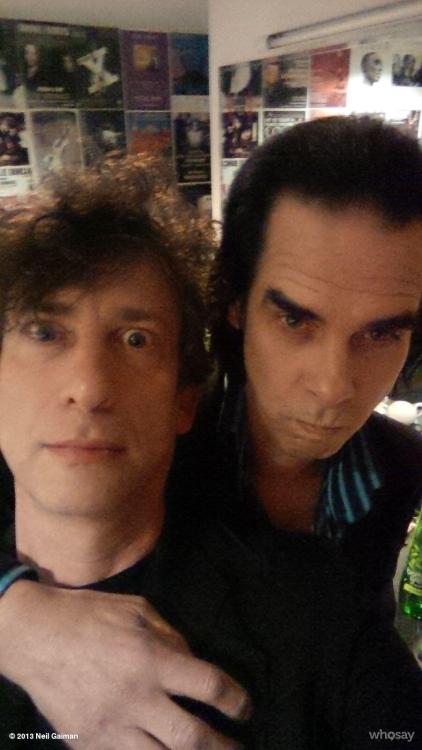
Neil almost always looks like this
Selfies are just annoying, facile pieces of jetsam that clog the Internet pipes, and only gets noticed by the mainstream media because it's jumped the generational gap and adults have started doing it.
Notably, famous people - because it fits so well with Twitter for building a one-to-one relationship with fans, like Lady Gaga persistently tweeting pictures of her in bed relaxing after a gig. Clearly we have different definitions of relaxing, but at least it keeps large sweaty alarming men called Barry from climbing her walls to peer in her window. Now he can do it safely from his parent's basement.

Except of course, I'm a humongous hypocrite. I nearly went into fan overload when cherished counter-culture author (who also wrote a naff Doctor Who episode but we'll let it slide) Neil Gaiman tweeted a selfie of him and supernaturally young-looking antipodean rock renegade Nick Cave. Between Gaiman's atypical 'Englishman abroad' look of adorkable perplexion and Cave's stock expression of pensive, universal malaise it's a beautiful and hilarious and unique moment for fans of both, of either, or of clever individuals in general.

Ground Control to Major Tim
...
The selfie, ironically, cuts two ways - for every smouldering expression that brightens your partner's mobile, there's a duck-faced pout that ends up shared on 4chan. It's a surprisingly persistent piece of internet nonsense, and I suppose it fills the blank spaces of the world's media that we'd only be wasting on more wars in the Middle East, more corruption in America's boardrooms, and more taxpayers money avalanching into ramshackle banks.

Because the real threat to the future is an annoying social-media trend...

Wednesday, 18 April 2012

UC Davis, the Pepper Spray and the Occupy Protestors

Currently doing the rounds of Facebook is an enlightening blog post on the recent release of the Reynoso Report into the infamous pepper-spraying of passive student protestors at the University of California in Davis, America.

The blog criticises the frequent communications breakdowns and misunderstandings by University authorities and security services, as well as alledging some worrying oversights in terms of what campus police officers are permitted to do. It makes for interesting reading, but as with all independant bloggers, it bears considering with an open mind and the necessity of evidence.

Of greater interest to myself as a journalism student, is the response to the release of the report through the international media. I did some digging to see how various news outlets covered it, at least online.

Firstly, I turned to possibly the most recognisable voice in the Western media, the British Broadcasting Corporation. Their coverage of the UC Davis report? Nothing since the incident, back in November 2011. Even trying additional combinations, such as 'Reynoso' or 'California Pepper Spray' either return nothing or unrelated stories. A similar search at Channel Four News also returns nothing since November, whilst the ITN website oddly offers no search function.

Examining the print press websites, staunchly left-wing, liberal-attitude British broadsheet The Guardian ran an article on the same day as the report was released, available here.
Crossing the floor, I searched through the website of The Times, a flagship title of both the UK and Rupert Murdoch's News Corporation. Whilst their website is barred to non-subscribers, it is possible to search their article history at least. A search on 'UC Davis' or 'California Pepper Spray' both turn up the same results - no articles on the incident since November last year, when it occurred.
The same goes for the other NewsCorp title in the UK - The Sun, which published an article on the 21st November, and since then hasn't come back to the topic.

Trailing behind The Sun, which is the British newspaper with the highest circulation is the Daily Mail, who published a surprisingly sympathetic article - given the Mail's usual conservative, right-wing and pro-authority stance. Even more surprisingly, they followed this up with another article looking into Lieutenant Pike - the officer at the heart of the incident - and his history with campus police, as well as reporting on the response from notorious internet-based activists, 'Anonymous'.
However, since November of last year they have not returned to cover the topic, or discuss the release of the report.

I decided to cross the ocean and see how the American national media was covering the latest development in one of the famous stories to emerge from the Occupy movement. To my surprise, I found that Fox News, a foundation stone in News Corporation and infamous for its severely conservative viewpoint actually returned to the story in February 2012. They produced a short video story on how several of the students sprayed and arrested in November lodged a lawsuit demanding damages for violation of their civil rights. Of less surprise was that since that story, a search for related articles on both date and relevance turns up nothing new.
In contrast, Cable News Network ran a lengthy article on April 11th this year, the same day as the report was released. It appears that CNN is also famous for its 'liberal bias' - the wikipedia article is sourced here as a directory to the various articles and claims made on this basis, rather than evidence.

Running through the American print titles, the New York Post had nothing new, whereas sister paper in the News Corp Empire - the Wall Street Journal - did indeed carry an article that isn't available to non-subscribers. A search using Google turns up a vast array of American regional titles carrying their own stories on the report, and that is where my own article began.

I found the initial blogpost, and decided to see how it was being reported in the wider media. That's how I discovered the surprising silence emanating from some of the biggest news reporters in the West. Quite why this story is being buried is another question that deserves consideration by all of us together.

Wednesday, 24 February 2010

Sie Verlassen Den Amerikanischen Sektor

First Posted 9th November, 2009


On November 9th, 1989, at a haphazard press conference, the Deutsche Demokratische Republik announced the revocation of the strict border controls that existed between between the nations of Germany, and the cities of Berlin.
That night, the Grentztruppen forces manning the checkpoints along the Berlin Wall* were swamped by hundreds of thousands of Eastern German citizens, demanding passage to the West. Like the superbly-trained Warsaw Pact troops they were, they immediately referred to their superiors for orders - but unsurprisingly, no senior NVA commander wanted to be the man to authorise the shooting of unarmed countrymen, women and children. The checkpoints were thrown open, and the Iron Curtain was breached for the first time in forty-five years.

That night, East met West in an ecstatically celebratory atmosphere. Within a few months, the Wall - the antifaschistischer Schutzwall that represented the edge of the Western World, and the start of the East - was in ruins. Within the year, Germany was reunified and the DDR was in ruins. Within two years, the USSR imploded, and half a century of suspicious co-existence and the spectre of nuclear annihilation was banished. The face of Europe was remade, the hands of the Doomsday Clock were pushed back seven minutes and freedom flowed like a flood across the former republics.

I've been thinking for most of the day what event within my lifetime could possibly compare to such an auspicious occasion. Indeed, there are probably not too many at Leeds Trinity who recall watching with the world as the wall came down - the staff, and a handful of mature students; myself included, who vaguely recalls, on a tiny, grainy screen a mob of very happy people standing on a wall that I equated, in my five-year old mind, with the sea defences of my home town!

I've not progressed too far from that confused young boy. One tries to think of the definitive events of my own, rather brief life, and came up with few equivalents. The 1992 Maastricht Treaty, 1998 Good Friday Agreement, the 2001 Attack on the WTC, the 2007 Attacks on London Transport, hell...to me, the transition from Humberside to East Yorkshire, the county where I grew up, in 1996 was highly confusing to a young man just starting senior school.
But can these events arguably have had the same impact on the world? I remember recoiling, mentally and physically, from the events of September 11th - but how has it affected a nation, a world already enmeshed in the struggle against terrorism? England had endured a legacy of senseless attacks from the 'freedom fighters' of Ireland, and in its way that made the bureacratic, concession-laden 1998 Agreement of little public impact. The same can be said of Major's limp into the EEC in 1992, and a world inured to violence has already recovered from the July 2007 attacks on London.

I wonder, with the demise of the super-power and the dismissal of mass extinction at the hands of nuclear war, if we have become a world reduced to regional, theological, economical, tribal squabbling with no comprehension of worldwide events. The ratification of the Lisbon Treaty has barely emerged from the pages of the broadsheets, where it exists more as a stick to beat Government or Opposition - and I wonder what we will read on December 1st, 2009.
Returning to the present, I was looking forward to catching some coverage of the Twentieth Anniversary celebrations on television tonight. I grew up reading le Carré and Deighton, Forsyth and Clancy, and have been fascinated with this front-line of the Cold War for years. Unfortunately, it seems the controllers at the BBC, ITV, Channel's Four and Five, Sky, etc., have different ideas and I can find nothing showcasing that definitive night, twenty years ago.

I will turn, instead, to the Guardian's website, and scour their aggregation of media to feed my interest. Abstractedly, I think of how we've been discussing how people pursue their needs through modern journalism, and how convinced I was that I was satisfied with the rustling, ungovernable size of a broadsheet. Now, I intend to sample a newspaper's website and its multi-platform reporting to appreciate an event.
It's interesting to note how the media has rapidly evolved, and as a result, how my opinion on it has changed accordingly. It seems we can find every angle and perspective on an issue...

It just seems like there are no more serious issues to consider.


* - And the Inner German Border, but the demarcation line had less PR appeal than its more photogenic urban cousin!