Showing posts with label journalism week. Show all posts

Monday, 24 February 2014

Journalism Week 2014 and Harold Ramis

Rather than an in-depth article, which I am intending, I just wanted to update today with a few succinct points to keep my hand in the blogging field.


It is the 2014 Journalism Week at Leeds Trinity University, the alma mater and the first in three years that I haven't been able to attend. Thankfully, it can all be followed on twitter via the #ltjw hashtag, and following @JournalismWeek, and reading the official blog of the post-grad team, and watch it live, and...

Well, suffice to say I am very envious of those attending. It was one of the motivating factors behind Leeds Eye View, and you can read my multimedia updates from previous Journalism Weeks in my archives.

One of the articles I've most appreciated coming out of #ltjw 2014 has been by post-graduate lecturer Richard Horsman, and it's a wry lesson for the exuberant, ever-connected generation. I hope some of the student hacks at Trinity take this lesson to heart!

When I saw it pop up on Twitter, I was inspired to comment to him as below:
Much of the hue and cry about the 'death' of old Journalism and the rise of the blogger has since subsided in the face of, dare I say it, common sense. The call is not for old-fashioned trained journalists to be replaced by the smartphone and wifi - but for the journalist to add those tools to their armoury!

T-T-T-T-T-T-T-T-T-T-T-T-T-T-T-T-T-T-T-T

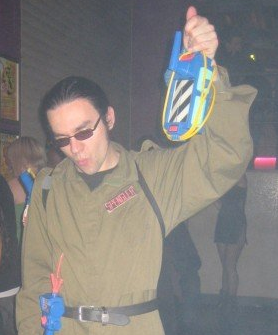
 On a more sombre note, today American actor, director and producer Harold Ramis has died, aged just 69. Like many British kids who are proud nerds, I grew up watching Ghostbusters over and over and over again. Ramis' potrayal of the awkward, brilliant, and surprisingly sly Dr Egon Spengler was to me how footballers or pop stars must appeal to the regular, sporty, confident kids. 
Still a favourite fancy dress outfit!
Spengler was a hero, a goal to aim for - if perhaps a little less nebbish - and proof that having brains was not an obstacle to becoming popular and achieving goals. The man saved the world!

He helped me feel more at ease with myself during adolescence, instilled in me a love of intelligence for knowledge's sake, and an appreciation for a dry, deadpan delivery. I am not surprised to read the list of contemporary, feted directors and producers who cite Ramis' quiet work behind some of the classic Eighties comedies as such a great influence.
Ramis' comedies were often wild, silly and tilting toward anarchy, but they also were cerebral and iconoclastic, with the filmmaker heeding the Second City edict to work at the top of one's intelligence. This combination of smart and gut-bustingly funny led a generation of comedic actors and filmmakers — including Judd Apatow, Peter Farrelly, Jake Kasdan, and Adam Sandler — to cite him as a key inspiration.
That's a legacy any Hollywood veteran can be proud of. I was grateful for an awesome character in a brilliant comedy that will undoubtedly stand the test of time. My thoughts are with Ramis' nearest and dearest, as well as fans around the world.

Courtesy of Ghostbusters Wiki

Thursday, 28 February 2013

Journalism Week 2013 - Neil Wallis, former Executive Editor of the News of the World

Possibly one of the most highly anticipated speakers at Journalism Week was Neil Wallis, lauded in our programme as a former editor of The People, Executive Editor of the News of the World, and member of the Press Complaints Commission.

He was one of many journalists arrested following the phone-hacking scandal in 2011 on charges of conspiracy to intercept mobile communications. Just recently the Crown Prosecution Service dropped their case against him, citing a lack of evidence to secure a conviction.

If there is a man more qualified or able to talk to us about the journalism industry and the Leveson proposals, then we haven't met them yet! Certainly, the tone was set before he even began with his presentation entitled "LEVESON: Devil in the Detail - Why Inquiry Report Threatens Press Freedom In More Ways Than One". Quite clear what his feelings on the reforms of the media are!

Neil was introduced by his former employee, and current Leeds Trinity Senior Lecturer in Media Law - appropriately enough! - Nigel Green. It was a perfect moment for Neil's phone to ring, and one wag in the audience (I have my suspicions about who!) shouted "It's Leveson!" to laughter all round.

Turning then to the serious, Neil was candid about his arrest, his bail and his subsequent exoneration - "It's scary. You feel like wetting yourself! It brings everything to a grinding halt - your life, your family, your career." The mood of the room was actually sympathetic, and it will be interesting to see if that holds up tomorrow when we're joined by Professor Brian Cathcart of the Hacked Off campaign, bitter ideological opponents to Mr Wallis and co.

Back to today, and Neil - cleared of all charges - has now set his sights on those arguing for the toughest of press reforms as proposed by the Leveson Inquiry. He painted a very convincing picture of the dangers of appointing a statutory regulator - specifically one backed by (and therefore dominated by) Parliament.

A Parliament, of course, that is wracked by scandal, corruption and ineptitude - see left!
There has been no end to the procession of crimes and misdemeanours of our elected leaders - exposed, naturally, by the Press they're now struggling to gag.

Hitting the topical angle, Neil referred to the Rennard scandal engulfing Nick Clegg's Lib-Dems, and how it was broken by a Journalist, those self-appointed detectives that the Deputy Prime Minister has made inadvisable enemies of!

Picture courtesy of @DMJHull


He spoke rousingly and charmed an audience of - I'll be honest - naieve journalism students who have been raised on a diet of cynicism towards the Government, even though their (our?) faith is still in the Guardian and the ethical correctness of the Leveson Inquiry. Nonetheless, it's clear to see how he was able to wield such influence over a Murdoch newsroom - and we're only seeing the beauty of charm and not the 'Wolfman' beast!

When the Q&A came around after a very quick half-hour, Neil made it clear how he'd tackle press reform. Trinity Journalism Graduate, and next Paxman Ben Cropper asked him if the Press Complaints Commission - of which Neil had sat on the board as a tabloid Editor - was a "toothless watchdog".
Neil responded forcefully that the PCC simply lacked stronger investigative powers - which seems surprising as the main complaint against the PCC seemed to be its lack of punitive strength instead. As an editor, however, Neil stated how he spoke to the PCC practically every day, checking the suitability of his stories - and is that a comment on other editors who might not have held to that admirable practice? He made it clear that "People were not arrested becase they broke the Editors Code of Conduct - they broke the law. The PCC couldn't stand in the way of that."


At one point he turned the entire Q&A on its head and asked us at one point we'd fall back on that tried and tested method of chequebook journalism. I couldn't tell if the silence that greeted him was moral in fibre, or just squirming! A few hardy souls ventured to admit they'd pay out for stories, and uppermost in my mind was securing the Telegraph scoop on the Expenses scandal. It was an interesting moral conundrum, and he continued the theme when asked if there was indeed a culture of criminality amongst the tabloids - "No, but I know a lot of journalists who sail bloody close to the wind!"

It's fair to say Journalism has always operated in the 'grey' areas, both morally and legally - indeed, it's probably where it's most needed. I had decided long before this session to get into this as far as possible, and tweeted a former Journalism Week guest - infamous tabloid apostate Richard Peppiatt. 


I asked Richard what I should specifically put to Neil, considering their naturally opposing viewpoints on a common topic. By the wonders of modern technology, the link to the right will show you all of Neil's talk and at 43:35 I am the person who asks the question - "Regarding press freedom, which you have discussed extensively and proudly, how do you reconcile it with the fact that all 175 titles owned by Murdoch simultaneously supported the Iraq War?"

The response I get is somewhat confusing - not certain that I would describe Rupert Murdoch's work as "left-of-centre papers". Nor would I describe all of his titles as "not being huge opinion formers." And his decision to mention the 'Editor of the Times' as opposing proprietorial influence seems laughably inappropriate!

Raising the most eyebrows, of course, is Neil's vehement response to Mr Peppiatt which came across as a violet drubbing. No less energetic is his attack moments later on Professor Cathcart, but Richard himself has already been responding to the comments via Twitter and the Journalism Week hashtag #ltjw until just recently, several hours after the talk has concluded!

Will the Hacked Off campaign respond equally forcefully to this tabloid supremo turned press freedom fighter? No doubt there will be even more exciting developments as Journalism Week comes to an end for another year, continuing the theme whereby I ask impertinent questions of important people!

Until tomorrow...!


Tuesday, 26 February 2013

Journalism Week 2013 - Mark Bradley, Yorkshire Weekly Newspapers - Group Editor

We went regional with our final speaker on the second day of Journalism Week - Mark Bradley is Group Editor of fifteen West Yorkshire titles including the Wakefield Express, Dewsbury Reporter and Halifax Courier. 

Mark Bradley introduced to #ltjw by Susan Pape,
Assoc. Principal Lecturer in Journalism
An eighteen-year veteran reporter, then sub-editor and finally editor responsible for all the titles mentioned above, it was clear he was going to speak with a great deal of experience behind him.
He approached Journalism Week with an unprecedented amount of hard, and good, advice for training journalists, saying "I'll tell you what I'm looking for when I'm recruiting for my newsrooms." He wants reporters who can quickly take pictures, get and edit video, write good copy, write their own headlines, sub their own work and put it all on a user-UNfriendly Content Management System.

It's another brick in the wall of multi-skilling journalists - but more than that, Mark doesn't want staff to forget the "fundamentals - finding and telling stories. How you deal with people everyday will define you as a journalist, and what this course does is train you how to go out and TALK to them - not sit behind a monitor and press keys."

It's valuable stuff for a room full of training reporters, many of whom will be job-hunting within weeks. Demand for a position well exceeds the actual vacancies - Mark informed us if he advertises for a position, he will get at least 50 applicants!

How should the potential employee stand out from the crowd then? The answer is at the heart of regional journalism - that the journalist should be vitally aware OF their region! Any good editor wants to see in the covering letter itself a true awareness of the 'patch' you'll be covering, a real familiarity that will lead to good, in-depth writing.
Back that up with a reference as well - and make it a good one! If you can, make it someone already working on the publication who knows you. "I want to be able to pick up the phone and speak to someone who can tell me in a few minutes if you're right for the job."
Finally, Mark observes "I've never had a video application!" I'd already been considering a show-reel style portfolio on Youtube as an application tool, but now a room full of competitors know, I'd better get on it quick! The lesson here though is a combination of local knowledge, proven skills, and ability to improvise a novel approach - all keys to standing out from the crowd.

Mark turned next to the real challenges facing regional media, dealing with monetizing their work and balancing the digital/print demand. "We want to chase new demographics, of course, but we don't want to alienate our existing customers. Print is still our priority, and whilst it might change in 12 to 24 months, but many of our core demographics don't have access to high speed internet" - so, a flashy website is entirely wasted on your key customers and what content might you have sacrificed in the course of going fully 'digital'?

It's an interesting conundrum which must be facing regional titles and broadcasters across the country, and it's even more crucial when you consider a key message of Journalism Week is the importance of starting with local media - either as a stepping stone to national and international work, or building a solid career with your hometown title.

Mark echoed other common themes of the week, such as advising against too much dependance on Facebook or Twitter. "They're valuable tools certainly, but they are no replacement for properly curated content." He cites well-known examples of social media driven stories that have exploded spectacularly in people's faces, with names like McAlpine and Bercow ringing warning bells across the nation.

During the Question and Answer session, I asked him what he thought of hyperlocal blogging, and citizen journalism - did they compete for custom with their increasing popularity, and lack of commercial dependance versus his more traditional media?
"I think bloggers, and micro-local journalism, are really just part of the landscape that live alongside local newspapers - for the moment. We aren't really in direct competition."

He stressed the kind of 'brand loyalty' that publications like the Yorkshire Evening Post have, which is key to the success of regional media - and that loyalty is assured as long as they retain 'integrity', which causes him to comment on the post-Leveson world of journalism. "Our readers now come to expect a higher quality, less 'in your face' style of reporting that is less tabloid. They will actually complain if we become too tabloid, that's a definite shift after things like Leveson and the closure of the News of the World."

I found that a particularly interesting point, and after the applause and thanks I stopped to ask Mark to expand a little further on it for a video.


Journalism Week 2013 - Trevor Morris, Public Relations Supremo

Another Journalism Week has begun, courtesy of Leeds Trinity University and their Centre for Journalism - where I am a final year student on a Journalism BA.

I've blogged about Journalism Week previously and this year will be no exception. When not blogging, you can follow the action on twitter via the hashtag #ltjw, the account @JournalismWeek and the liveblog and livestream. We don't just talk about multiplatforming - we do it!


Today we had a couple of firsts - our first PR representative, albeit now resigned from the industry to become our first journalism academic, Trevor Morris.

The theme of his presentation to us was "Is PR good for us?" - an interesting concept to a room full of cynical veteran journalists and their proteges!

Indeed, he asked how many in the room were specifically PR students, and the lone few hands that went up were heavily outnumbered by the 'pure' Journalists!

Unabashed, he pressed on with his lecture which portrayed PR as "hard to describe, easy to malign" in my words. He discussed the steretotypes of the PR operatives, such as the male Machiavelli and the female Strategist - but the truth is actually of a well-connected corporate employee who probably knows as much as his CEO or Minister about the doings of their company or Department.

He confirmed my suspicions about the divide between Journalists and PR staff - the divide between good jobs and pay versus no work and scant earnings, with no medals for guessing who gets what! But more than that, that contention between the camps is actually a good thing. As a citizen, he says, he wants reporters to be sceptical of the PR line - "holding the powerful to account" as we were always meant to do!

Indeed, he freely admits that good PR must 'mislead in order to keep their clients interests' - and equated it with a Journalist deceiving to protect their exclusive. Are these deceptions necessary to our work? Some tweeters were still reserving judgement!

During his busy Q&A, Trevor was clear on his morals stating he'd never lost his principles over his work. At a time when Journalism is still recovering from Leveson, how many hacks can claim the same?  


Friday, 9 March 2012

Leeds Trinity Journalism Week - Conclusion

Well, #ltjw wrapped up last Thursday, and immediately after I fell foul of some horrible stomach complimant that briefly resembled appendicitis enough to alarm my GP. I hope no-one else leaving the week-long conference suffered as much as I did over that following weekend and into the next week. Typically of course, I promptly caught a cold directly after so this is the first chance I've had to drag myself back to the work left undone since then!

Firstly, you can follow this link to read my liveblog from a talk given by Richard Peppiatt, former Daily Star reporter and tabloid factotum. A recording of his lecture can be found on youtube and you'll be able to navigate to entire talks given by other speakers from the @JournoWeekLIVE account.


So the accounts of what took place are widespread and easily accessed. What were the impressions we took away from this remarkable lineup of journalistic commentators and contributors?
In short, nothing is more valuable in the current media climate than experience. Many of us had just returned from a six-week foray into the professional world as placement students - I've referred to some of the work I did at regional paper the Yorkshire Evening Post. The repeated message from our speakers was to go further, and grab every chance to create content that will give you skills and experience.

Social media was of course touted as the platform of choice, especially in an entertaining and eye-opening lecture on mobile device-enabled journalism by Chris Payne, better known as @documentally on twitter. The future of more traditional media was reassured by BBCbigwig Mark Easton, who sees established broadcast journalists as gatekeepers of hard facts in a world of information overload, but even he said "if you aren't blogging and tweeting, what are you doing?"

We touched many times on the implications of the Leveson Inquiry, including a very frank talk from former News of the World journalist and current freelancer Chris Tate. He took the surprising position of defending the fallen paper, currently at the heart of the some of the worst excesses in tabloid reporting and unethical collaboration with the authorities. From his point of view, the NoTW had a mission to hold the powerful to account in a country with a notoriously weak system of checks and balances. Whether or not it achieved that goal will be decided by the Inquiry.

I put some of Chris' opinions to notable tabloid apostate Richard Peppiatt in his discussion with us towards the end of the week, as linked above. In a balanced response, Richard acknowledged the work the NoTW achieved working with individuals who had suffered and used media exposure to benefit their campaigns - but cautioned us against forgetting the many more who wanted no contact from the vulture-like circling of 'hacks', citing examples such as Chris Jefferies, pilloried by the media after briefly being suspected in the Jo Yeates murder.

As well as where journalism can end up, we discussed in great detail where it can start, and concluded that it can start anywhere, at any time! For Dave Simpson, long-standing Guardian music critic, he freely admits he fell into it and had no prior training. Many of the questions from students were - how important is this degree I'm spending time and money on, then?

The final Q&A, with recent graduates from the university's Centre for Journalism, addressed that question in a panel setting. The alumni explained that a qualification proves your grasp of the theory, and may attract an employer's attention, but if it can't be backed up with hard, proven experience in the real media world, it simply cannot stand on it on.

Any spare time needs to be given over to interning, volunteering, blogging and tweeting to make a name for yourself. There may be less jobs out there for prospective new journalists, our guests told us, but the editors and directors, producers - and consumers - are just as desperate to hire the new talent as ever.

Thursday, 1 March 2012

Leeds Trinity Journalism Week - Ongoing

As well as tweeting like crazy (you can follow me @timLinkinister) from #ltjw, I've also turned my hand to live blogging on the University's official blog.

You can read here my coverage of the talk from Nicola Rees, a Video Journalist from BBC Leeds, and over here is my blog on Christian Payne, a Social Media and Tech Commentator.

From twelve today I'll be liveblogging again, this time for legendary tabloid apostate Richard Pepiatt, so make sure you're monitoring the blog!

Monday, 27 February 2012

Leeds Trinity Journalism Week 2012 - Mark Easton

Auntie finally got a look in this morning with Mark Easton, Home Editor of the BBC. He was candid about his entry into journalism - "I've never applied for a job in my life." He described his career as a skydive, and encouraged all of us to grab opportunities where we could.

Turning the tables somewhat, he asked the audience why they wanted to get into journalism. Excellent way to shut up a room full of hacks, nobody tell the politicians. There were some admirable goals - "hold the powerful to account" and such - but I kept quiet, as I thought "Being sent to review gigs" wouldn't really stand up in this Leveson-dominated era.
He praised those of us with high-minded ideals, and recounted how his tour of duty on the ink, paper and whiskey-soaked Fleet Street in the eighties had knocked some of the starry-eyed optimism out of him. It was telling that people chuckled more at his straight-faced comment about journalists looking to make an "honest dollar", than there ever was at his rolling oratory on booze-soaked hacks of yesteryear.

Reading occasionally from his book Britain, etc. Mark mentioned the 'Westminster bubble' of politicians, lobbyists and journalists who essentially set the entire national news agenda. He also referred to our responsibility as journalists to the 'numbers' - statistical news - and accurate reporting of science, two crucial matters which have often brought the media's reputation into disrepute.

He opened the floor to questions, and was immediately hit with the moral responsibility of journalists to follow the law when reporting. Reflecting on the constant grinding of the Leveson Inquiry, Mark said "there are going to be times when journalists frankly need to break the law" but qualified this remarkable statement by saying that journalists who do deserve to be prosecuted.
A formal and viable defence of Public Interest should be introduced to deal with situations where a journalist has acted in the greater good by breaking the civil - and even criminal? - laws of this country.
Is the PCC a toothless watchdog then? Yes, he responded without hesitation. The media needs a regulator with more cojones he said, reminding us that he - and the BBC - work under the scrutinising eye of Ofcom, a much tougher regulator.

Looking to the future, he advised us that "statistics are where it's at" and fully supported the moves to offer training in data reporting, a theme I feel will be echoed by many speakers in the wake of the latest Wikileaks release.
Mark turned a critical eye on regional media, which is a favourite bugbear of the Corporation, and stated "local papers are rubbish at holding local government to account", accusing them of being "entirely driven by advertising."
I tweeted this controversial opinion to the editor of our regional (who secured my placement last month) and Mark quantified his statement to us both later this afternoon - "Arguing local paper industry not where it was in holding local democ to acct."

Mentioning twitter, Mark urged enthusiasm in all forms of social media. "If you aren't blogging, tweeting, WRITING - well, what ARE you doing?" He knows the future will be in social media. So where does that leave the traditional media that he and the regional press use? It'll be the "stick in the sand", a lynchpin in a shifting, confusing world of cutting edge new media. Not a stick in the mud, I clarified on twitter.

It was this traditional media as well that was at the heart of the problem in British journalism - that the balance of privacy is just not write. He spoke disparagingly of the "unforgiving firestorm" of press attention that can destroy careers and lives when people who happen to be in the public eye make a personal mistake. A very humbling point of view I felt. I was also driven to ask if glorifying tales of whiskey-fuelled reporting wouldn't end up breeding a whole generation of replacement Alistair Campbells, but Mark was quick to clarify that the 'golden age' of Fleet Street caricatures was long past.

Instead, he urged us, disregard these tales of fewer journalism jobs being available and more applicants gunning for them. Employers are just as desperate to find some shining new talent, as you are to land your career in the field. The chances are there!

He concluded with words of encouragement for those of us spending thousands (or racking up thouands in debt) to be qualified as a journalist when a mobile and a twitter account allow the 'citizen journalist' to scoop an exclusive just as easily.
He said "The definition of a journalist is becoming much looser. It basically depends on the quality of material being provided." Never discount the ability to analyse and interpret the material, which is actually what we're trained for.

---

That blog post went on for longer than I was intending! I'll write up the talks from Peter Salmon (BBC) and James Ball (Guardian) in a new post later on.

Monday, 28 February 2011

Incoming! Journalism Week returns!

Last year I launched LeedsEyeView during Journalism Week I, to put across my blog reviews of the speakers at Leeds Trinity's Journalism Week event; allowing industry individuals to come in and speak to undergrads, postgrads and interested parties about their opinions on the nature and future of Journalism.

The event returns for 2011 and I will be blogging later today about Joanna Geary and Adam Westbrook who gave us an online-flavoured, rather opposite-themed assessment of the industry. Keep me tagged for further updates as the week proceeds!

Friday, 26 February 2010

Helen Boaden, BBC Director of News and Alan Rusbridger, Guardian editor-in-chief

Firstly, my apologies for the late entry of this blog, at some four hours after the event. Normally, my retrospectives on the Journalism Week speakers have been delivered directly after the sessions, but in this case various factors conspired to prevent me from timely updating!

So, then, to the jewel in the crown of Leeds Trinity's Journalism Week, where Helen Boaden of the British Broadcasting Corporation joined Alan Rusbridger, editor-in-chief of the Guardian newspapers, in a session chaired by Leeds Trinity media lecturer Mike Best. Helen spoke to us passionately about the future of the BBC, by quickly referencing that 'monster in the basement', former Director-General John Birt who for all his unpopularity (both within and without Television Centre, it seems!) dragged the BBC "kicking and screaming into the digital age...securing a massive strategic advantage."
An advantage the Corporation has seemingly not overlooked, as Helen waxed eloquent about the permanetly-staffed and funded hub for user-generated content the BBC employs to retrieve, filter and utilise what is created when the "consumers are newsgatherers."

Referring to specific examples of such content, she mentioned the coverage of the Iranian election protests which because of the nature of both the situation and the nation, had to be conducted entirely by 'citizen journalists' on the scene with cameraphones, laptops , blogs and internet connections. She cautioned about the double-edged nature of such news, explaining that although the material came with a unique and personal viewpoint, and was often direct and exciting, it was clearly slanted heavily in favour of the Iranian political opposition, and was often factually incorrect.
This moved us on to the topic of trust, a thorny issue for both the BBC and the industry as a whole; Helen firmly believed the BBC would remain a "trusted authority" over significant issues such as catastrophic weather or financial meltdowns, and that media consumers would prefer a "big, reliable, trusted brand" over "pert and facile" observations on some new media outlet. Her opinion was that "discerning and curious" consumers would - hopefully - trust the BBC.

Alan's very first topic was that of Rupert Murdoch's 'paywall' concept, that has set the media industry to near-rabid speculation about the future not only of revenue, but of the core concepts of journalism and editorial control themselves. Alan's attitude is very much one of contemplative patience - he refers to the sequestering of desirable content behind paid-for access as a 'hunch', a gamble taken by a man noted for challenging conventional thinking, and succeeding.
This immediately made me wonder if Alan himself is gambling on 'hyperlocal' publishing, by operating Guardian: Leeds, a section of Guardian online dedicated to blogging just within my fair city! Indeed, there is a chance you reached this blog through that fine website, and so is Alan 'inspired' or 'terrified' by the work now being carried out under his name?

Inspired and terrified were the words Alan used when he first encountered William Perrin, the original hyperlocal nonjournalist, to describe how the future of Journalism might be affected.
It was at this point that I realised Alan was covering much of the same ground as his Hugh Cudlipp Memoral Lecture, but the points he was making and the audience receiving it were just as vital today. Going into finer detail, he took us through the concept of crowd-sourcing, when the Guardian was able to cease paying £100,000 to business analysts explaining what Barclays was up to regarding it's 'Tax Gap' - by uploading an acquired Barclays internal memo directly to the internet, and asking readers to interpret the meaning. The relevation was that Barclays were brazenly discussing methods to mislead HM Revenue and Custom over payments, and although the Guardian received what Alan jokingly referred to as a 'pyjama injunction' - when a High Court Judge on duty is hauled from his bed to fire off a gagging super-junction - the document was now held by those legendary internet custodians of truth, Wikileaks.
Budget changes specifically aimed at pursuing tax evasion were soon announced, and Alan was able to describe the direct impact of responsible reporting. However, such responsibilities cannot be shirked and Alan had to wrap up quickly and depart for work halfway through our Q&A.

Instead, Helen Boaden had to face the first query of the day from some obstreperous young man who decided to ask about the sudden news story of the morning about the leaked Strategic Review Plan for the BBC which will see 25% of staff and funding for BBC Online slashed, amongst other cuts. Her response was to immediately question the veracity of leaked documents, especially those not approved or even seen by her, and suspected the Trust themselves were responding with horror! She acknowledged the necessity of the BBC's currently ongoing 'efficiency programme' and said that although the past three years had seen a "glorious expansion" for BBC Online, she stressed the need for an appraisal period where the BBC "stepped back to evaluate what was working". Helen also expected the BBC to focus on "what experiments had worked, and what alternatives the market was offering", referring presumably to her earlier comments about BBC Online attempting to offer an "ambitious" alternative to local news on the web, which was originally rejected by the Trust.

Helen responded well to what was a truly left-field question, as the news had only broken that morning, and her comments made clear sense, as we have discussed in lectures about the overbearing nature of the Corporation's web presence. It will be interesting to see, however, how much of this leaked Review remains to next month, when it is presented to the BBC Executive, and what their official responses will be, when they aren't cornered by a rookie blogger at a presentation!

Wednesday, 24 February 2010

Tim Singleton, Head of Foreign News at ITN, and Chris Ship, Senior Political Correspondant for ITV News

Today's talk was delivered by two Leeds-educated journalists, and Chris Ship was a 1996 graduate of Leeds Trinity university himself! His colleague was Tim Singleton, Head of Foreign News for ITN, and were present to discuss both politial and foreign correspondance.

The main thrust of their joint lecture was an advert for ITV's upcoming coverage of this year's General Election, but the trailer we were shown was unarguably impressive. It was well-targeted also, as undergraduate students represent the newest generation of voters and at a time when low turnout is crippling the democratic process, it was a wise move.
Moving to his own particular role in the industry, Tim explained how ITN's innovative attitude would be required to cover what could be the most dramatic election since the mid-seventies, with an increasingly likely chance of a 'hung' Parliament being formed by a Conservative party with a desperately small majority. He explained that the second day of the election would result in much political maneuvering and power brokering from the various parties, and that the coverage of this revolutionary activity would require revolutionary efforts from the press.

Continuing on this theme of political reporting, Tim referred to criticisms levelled at all Westminster reporters that there is too much coverage of 'personality' clashing, and not enough 'policy' reporting. Speaking in defence of this choice, Tim painted a realistic picture of good stories originating more from the human conflict than from painful and elaborate procedural jockeying.

Chris continued on this established theme, extending his predictions to a possible - and remarkable - Second General Election that could be held in the autumn, with Cameron as Prime Minister 'bumbling' through the summer with a weak majority, an event not seen in British politics since 1974.
Moving away from grim predictions, Chris described instead an equally fascinating event in the recent past, when Geoff Hoon and Patricia Hewitt launched a surprise coup against Gordon Brown on January 6th. Events began shortly after a rousing Prime Minister's Question Time, and by the 1.30pm bulletin Chris had to report on the uncertain events and all without the assistance of direct superior, Political Editor Tom Bradley. By 6.30pm, Chris was describing how many Cabinet members had rallied to the Prime Minister's support, and labelled the coup a 'brazen' attempt to challenge Brown's leadership. In the space of that day, Chris explained, the entire plot had begun and immediately failed, literally between two ITN bulletins. Such a rapid rate of events makes for very difficult but clearly exciting reporting.

Presenting an alternate view of proceedings at Westminster, Tim warned students that they 'could not overestimate the amount of managed information we receive' from politicians, special advisers and other Whitehall entities. Chris explained how the best information could come from utterly unattributable sources, men and women who would not risk rising careers by formally releasing information - and a picture of the machinations and scheming in the corridors of power is clearly formed, as shadowy figures trade information and plot downfalls, no doubt brandishing the press as some poisoned dagger straight out of some Yes, Minister sketch!

After the talk was concluded, I spoke directly with Tim about foreign news, as we had not had chance to cover it previously - I was curious as to how Tim would contrast domestic political reporting with foreign affairs. He was candid, and admitted that realistically US politicians, for example, have no need to speak with British journalists due to the lack of relevance; he told me ITN have been seeking an interview with President Obama to no avail, and he is not hopeful about their chances. I was forced to agree with him, although my interests lie in both national and international political fields.
He mentioned their foreign news bureaus, and I enquired after the relationship between ITN and the Chinese government in Beijing; Tim explained how certain topics regarding the People's Republic are utterly off-limits, such as the issue of Taiwan, and related to me how an ITN broadcaster was incarcerated for a day by Chinese authorities. This was clearly nothing more than a 'warning gesture' by the Beijing administration, but as I remarked to Tim, Journalism Week has portrayed the riskier side of the media industry that cannot be communicated well in a lecture theatre - and is, after all, the ultimate goal of this remarkable and informative experience.

Gavin McFadyen - Centre for Investigative Journalism

First posted on 23rd February, 2010

Both the significance and the risk of reporting was highlighted in today's enthralling talk by Gavin McFadyen, who amongst his many professorships and research positions is Director of the Centre for Investigative Journalism, based at City University, London.

This has become the hardest entry I've made on my impromptu blogging tour of Journalism Week, wondering where to begin and what to include. Gavin's talk was an effortless combination of hair-raising stories about uncovering corruption and confronting atrocities, with the nuts and bolts and sheer slogging work of investigative work. For the first time in our brief student careers, we were introduced to the real opponents of journalism - the hydra-headed boards of powerful multinationals who can ruin careers and crash finances, to the shadowy operatives of security services with the weight and power of government behind them, to nameless thugs hired by faceless bureacrats who can rob you of everything - including your life.
These risks are routinely undertaken by the people Gavin works with, and the significance of the stories they produce go light-years beyond the celebrity muck-racking of the Western press - stories such as Stephen Grey's revelations about CIA 'black flights' transporting suspects to undergo 'extraordinary rendition', a euphemism for interrogation up to and including torture, abetted by the British government, that violates UN treaty and international law.

Such names were not familiar to myself and the audience, and Gavin explained the peculiar reluctance of the British media in particular to become involved with Investigative Journalism, deterred it seems by the legal risks and ramifications. This remarkable view really stood out for me, halfway through a week of talks by leading figures in Western and British media - and illustrated perfectly the lonely, vital, dangerous and enthralling task that is Investigative Journalism. Gavin, and the new Bureau he has established at the CIJ work almost as pariahs, funding and conducting their own investigations, then having them released through the few friendly media entities such as The Guardian - unable to publish their own work, as no legal professional will safeguard their work.

Some of Gavin's more memorable phrases are down in bold in my notes, and I'll leave the most significant here - that the work a true Investigative Journalist must do is to Comfort the afflicted, and afflict the comfortable.

Duncan Wood - Yorkshire Television

First posted 22nd February, 2010

We received a very light-hearted talk from Duncan Wood this afternoon, but under the humour was a very helpful and clear-eyed view on practical journalism, its pitfalls and its perks! From the outset, Duncan stressed to us that he still wishes to be known as a Journalist, although he is more famous for presenting the regional news.

Duncan's origins are in stark contrast to the students he was lecturing, as he happily disclosed his lack of O-Levels (remember them?) and A-Levels, and the grudging praise and ready criticisms on his NUJ assessments. Of much interest to students was his statement that although he achieved an impressive 100wpm Shorthand qualification, he has not used it since - disheartening news for the faculty who have so recently re-introduced it!
On a more serious side, he advised us that a foundation of his beliefs is a stubborn determination to get to the bottom of any story, and this is also how he distances himself from other presenters who simply read from autocue, as some students were curious to know.
Continuing with this theme of deep investigation, and under inquiry from his audience, Duncan acknowledged that there is often a knife-edge balance to be held between personal morals and professional ethics, and the cold practicality of finding and reporting the story. Whilst we as students have covered the theoretical application of dry, Journalistic codes of conduct, we have not been trained in the gut instincts of conducting reporting, and of course - how could we?

Finally, he was quizzed on the new challenges facing regional broadcasting. Like many of his contemporaries, Duncan exhibitied a wary enthusiasm for the pilot scheme to be run in the North-East, and stressed to us that the success or failure of this field test will probably influence the entire deployment of independant local media - truly relevant, high impact news for all present.

Bill Thompson - New media commentator

First posted 22nd February, 2010

Handling arguably the most difficult topic on the week's agenda - and possibly on the entire Align Leftmedia industry's agenda - was Bill Thompson, new media commentator. I really enjoyed Bill's presentation, and his attitude of dry but informed cynicism was both refreshing and engaging.

His dissection of Murdoch's new initiative, the controversial 'pay-wall' concept sequestering specific content was succinct and enlightening on a painfully relevant issue in media. In the following Q&A, an informed audience member asked him if the practice was feasible on a small scale, referencing the Whitby Gazette and we discovered that in a small, group-specific environment such as very regional news, paid-for content would be a practical and rewarding business model, but Bill urged constant observation of what is a new and controversial practice. My understanding is that the risk of 'pay-walls' is twofold, both to ensure it is a financially-sound business model but also that it does not place draconian restrictions on news distribution.

Bill took us on a gentle but wide-ranging stroll through the future of journalism, and confirmed the one overriding fact I had in my mind - we can no more predict the future of media than we can next week's lottery numbers! This is such an exciting and unique situation, that is faced by few and far-between industries - where the future of our professional world is in such flux, and that we as journalists will be discussing and indeed influencing how that future turns out.

I tried myself to expand on this concept, but feel I worded my question incorrectly, when I asked if we ran the risk of making 'news out of the news', describing a spiral situation where journalists discuss journalism and its indiscernible nature in some kind of bizarre 'chicken and egg' scenario. Instead of a challenging and professional 'back and forth' debate, Bill assured me no self-respecting journalist would fall into the trap of discussing themselves and their industry, and if I were to try this theory at a party, I'd probably never get laid again.

Thanks, Bill!

Mike McCarthy - Sky News

First posted 22nd February, 2010

The first session of Journalism Week was with Mike McCarthy of Sky News, and was informative, intriguing and amusing. One of the most effective - and poignant - moments for me was when he was discussing the dangers of Conflict Reporting, and how his colleagues never even considered that they might not return. In careful terms, he explained how he - and presumably others - have had to consider plans for, as he put it, their own 'departure'.

At that moment, the true risk of reporting was illuminated for me. Of course, the danger to a reporter on the Yorkshire Evening Post doesn't really compare to the risk facing a Foreign Correspondent based in some global hotspot - but at the apex of this industry are presumably those jobs, reporting on stories that need to get out - even under fire, under protest, under threat. I've always been fascinated by Conflict Reporting, as true news on the front line (so to speak) and it really drove home for me the importance - and danger - inherent in the profession I've so recently joined.

Mike also discussed reporting on painful and upsetting incidents of domestic news, and as I listened I realised there is equal risk to your mental equilibrium communicating home-grown horror stories, as there is describing artillery fire from a hotel roof in some urban warzone. His recollections of reporting on the Hillsborough tragedy came across 'edited', carefully controlled - and he acknowledged to us all the honest, personal pain he felt as a result of being one of the first journalists on the scene.
As I absorbed this information, a new question rose up to replace the more detached and professional inquiry I had ready. How would you, an experienced reporter advise us - raw recruits in the media world - how to handle the emotional fallout of dissecting the raw side of human nature? What methods exist to shield your sentimentality and soul from regular exposure to the very worst the modern world can offer?

Unfortunately there was no time and, I suspect, no real answer to that question except painful experience and grit persistence.