Showing posts with label blog. Show all posts

Wednesday, 7 January 2015

Armageddon Will Not Be Televised

There has been a flurry of online interest in the surfacing of the fabled 'doomsday' tape from the vaults of the Cable News Network.

Ted Turner, founder of the first dedicated news channel in the US, famously claimed on the launch of his channel in 1980, that
"We gonna go on air June 1, and we gonna stay on until the end of the world. When that time comes, we'll cover it, play 'Nearer, My God, to Thee,' and sign off."
Now, a former CNN intern has proven that this was indeed Turner's plan. Hunting through the famous news network's video archives, Michael Ballaban found the clip that is only to be played upon confirmation of the end of the world. Thankfully it isn't specified what form that confirmation will take.


Created during the 1980s, with the Cold War ever at risk of going hot, we shouldn't question the merit of creating an emergency broadcast for use in the likelihood of worldwide Armageddon. We might question the choice of music, which was rumoured to be the final song played by the band on RMS Titanic.

What is surprising is, well, the surprise this discovery is being met with. Perhaps, being British, I have a more phlegmatic attitude towards "We interrupt this broadcast...", as the BBC and the British Government's plans have long been well known. In 2005, the media was discussing recently declassified files detailing planned broadcasts should a nuclear attack on the United Kingdom be confirmed, drawn up as early as the immediate post-War period.

Such a broadcast was laconically referred to as the "four minute warning", so named for the brief period between confirmation of inbound missiles and their impact on target within England. This in fact was the maximum possible time for British-based detection systems, and it could have been even less time.
On confirmation, the Wartime Broadcasting Service would have been activated, overriding all existing BBC transmissions to inform in classical, RP tones, the grave news.

Delivered by familiar BBC Radio Four continuity announcer Peter Donaldson, part of the broadcast has been spliced, aptly enough, into the song Four Minute Warning by Radiohead. Peter also briefly discusses recording the automated warning on this clip from The Culture Show.


These painfully real-world examples are chilling, but far more people are familiar with the fictional portrayals of nuclear devastation in England. The leading example must be Threads, the BAFTA-award winning drama produced in 1984 and broadcast to record viewing numbers for the week.

Set within the northern English city of Sheffield, it explores the true reality of nuclear war on a very personal level, introducing us to characters and their lives which are unfortunately being led in the vicinity of a high-priority strike target. Below is an amateur trailer of this powerful and eye-opening show.


The following year, Threads was shown again on the fortieth anniversary of the Hiroshima and Nagasaki bombings. In conjunction was the first ever showing of The War Game, a documentary from the 1960s that had been banned by the BBC. Although they have never stated precisely why, the bleak nature of the psuedo-documentary style would no doubt have swung a great deal of opinion against the nuclear arms race.

The War Game does indeed make for disturbing viewing. To show it in the Eighties, when nuclear weapons had become even more powerful than the cruder atomic bombs of the post-War period that featured in the production, must have been even more disturbing.

Or perhaps people were numb to the dangers of nuclear warfare? Perhaps they'd become accustomed to the reality of annihilation, delivered so calmly by familiar BBC voices ever since the end of the Second World War?

This is why I regard the surprise and fascination surrounding the CNN tape with some bemusement. I don't doubt every network has such an ominous pre-recorded piece, for such a dire emergency. We've had ours for quite some time.

The Hiroshima Peace Memorial
Taken by Aiden on November 24, 2006.


Friday, 3 October 2014

Doctor Who: The Caretaker versus Remembrance of the Daleks


Coal Hill School occupies a magical place in Doctor Who history, ever since William Hartnell abducted two schoolteachers back in 1963. The last time the TARDIS landed in East London, his Seventh incarnation had a confrontation with the Daleks and Davros that consistently ranks high amongst fans – not only for McCoy’s run, but for the pre-2005 episodes as a whole.

Last week, we had another episode set in that venerable education establishment, and I decided to stack Remembrance of the Daleks against The Caretaker in a versus review!

Saturday, 22 March 2014

Newcastle Film & Comic Convention - March 2014

It may be time to consider the title of this blog as I am spending more time in the North-East with the significant other! A couple of weeks back, I was enjoying myself at the Metro Arena for the first - and clearly not the last - Newcastle Film and Comic Convention.

Organised by the clearly experienced Collectormania company, the Convention nonetheless made local headlines when the two-day event was swamped beyond all predictions, leaving many - including some with advance tickets - queueing for hours in the bitter weather. According to the BBC's local news, attendance reached 15,000 which is a staggering figure outside London!


I luckily avoided this issue by sheer luck, turning up at around 10:00am on Saturday to buy on the door. Only an hour after doors opened, and the queue stretched the length of the Arena, but moved at a fairly impressive pace. Once inside, we decided to buy advance tickets for the following day in case the queues were longer. It wasn't until the early afternoon that I noticed visitors stopped at the doors - by this point the Convention was operating on the frankly barbaric one-in, one-out policy.

In Collectormania's defence, nobody could have anticipated the explosion of enthusiasm in Newcastle - when the cult convention circuit is dominated by the MCM Expo events of London and Manchester. It's heartening to see such focus moving further up the country, and I fully anticipate the convention staff being ready for a similarly impressive turn-out next year. Letting down advance ticket holders is a serious failing, it should be observed, but at the same time it is a rite of passage for convention attendance, when one realises the importance of turning up early!

A core component of these events, and a major motivation for my attendance, are the guests and NFCC scored a hat trick with the signing of three former Doctor Who main stars - Colin Baker, Sylvester McCoy and Paul McGann. Always firm favourites amongst the fans, even Colin Baker's inability to attend didn't dampen their enthusiasm. It was well-rewarded too - Sylvester McCoy is a consummate showman, and peppers his hilarious anecdotes with the clowning mischief that defined his early portrayal of the Seventh Doctor.
That mischief seemed most obvious when he casually dropped into the Q&A his knowledge that Peter Capaldi would be facing perennial nemesis The Master at some point - seemingly so effectively killed during John Simm's tenure. The sound of so many people gasping at once is quite unusual, I can assure you!

There were no spoilers from McCoy's replacement (in more ways than one), Paul McGann. The remarkably fresh-faced veteran actor wears none of his fifty-five years, and instead was a dry and witty spirit who seems to personally enshrine so much of the Eighth Doctor's charming bemusement. His reaction to the riotous fan approval of The Night of the Doctor was atypically British astonishment, his passion for the Audio adventures that have extended his Doctor's life is conversely so apparent. Although I have seen McCoy at conventions previously, McGann's Q&A was a new delight and I only believe it could have been bettered by having both men together. However, I doubt anyone else could have got a word in edgeways!

Fan enthusiasm also manifests itself in the Cosplay, easily the most visual component of any Convention. From obscure Japanese anime characters to expertly armoured members of the elite 501st Legion of Stormtroopers, via impossibly young and pouting clones of the BBC's Sherlock, the turn-out at NFCC was another healthy indicator of the fan potential in the North-East.
In my own small way I contributed, clearly to Sylvester's amusement - although any fan worth his salt knows McCoy personally disliked the most garish element of his outfit, the question-mark pullover. A core component of the recently-passed Ken Trew's design, McCoy has mellowed on his outre outfit in recent years, but between the novels set after the 1989 finale and the 1996 telemovie, McCoy's outfit never again featured that novelty knitwear!


Returning on the Sunday - this time with early-bird ticket clutched tightly in hand - we were whisked inside promptly and back for another circuit of the traders and merchandisers who make up the third, core part of a successful convention. Obviously the greatest portion is given over to the sale of back-issues of comics and DVDs of classic films, with the infamous Star Wars holiday special now in the front-lines of any self-respecting stallholder. The merchandise is catching up rapidly, and for the recent convert entire stalls exist to furnish the willing with whatever novelty headwear or mock weapons their costuming fantasies desire.

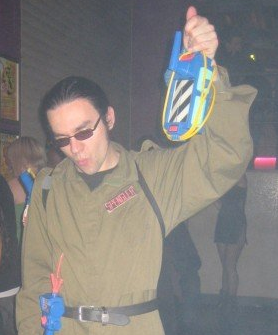
Recognition of that effort is also embraced by convention staff, and on Sunday I was actually collared by organisers of the Cosplay Masquerade, a procession of attendees in notably unique outfits. Regular readers of this blog will know that I recently paid my modest respects to the passing of Harold Ramis, and in keeping I had donned the original children's toys from the Eighties that comprised his outfit.
This originality had piqued the interest of the Masquerade staff, and before long I was stood on stage before several hundred convention visitors, who were cheering as I posed for photographs and laughs. Looking back, if anyone was to ask me - rightly so - what a grown man was playing at, wearing fancy dress like a child, I would tell them the satisfaction of giving amusement and entertainment to so many is utterly incomparable. I might not have won the Masquerade competition, and sincerely have no regrets. To take part is a singular honour, and gives such satisfaction in and of itself.


Wearily now, my friends and I took our leave, pausing only by a fan-made replica of the TARDIS console from Paul McGann's single televised excursion. Looking at this magnificent reproduction, I have to congratulate the organisers of the Newcastle Film and Comic Con for setting up - but even more so, I must praise the fans for convincing people to host a Convention here at all, and to turn out in such numbers and enthusiasm to make it all so very worth while.


My thanks to you all, and I shall see you all next year!

Monday, 17 March 2014

REVIEW: Wes Anderson's 'Grand Budapest Hotel'

Agatha is one of the myriad characters in Wes Anderson’s Grand Budapest Hotel, who works in a bakery, crafting exquisite cakes that one might associate more with the confectionery of Switzerland. Nevertheless it’s excellent visual shorthand for the generic Eastern European locale in which the titular hotel is situated, and a perfect metaphor for Anderson’s comedy-drama epic.

An elegantly spun, saccharine tasting construction, light on the palette, the film is gorgeous, lavish with vision and design and style. It venerates the cloying decadence of the last century, which still endures at the titular hotel in a kind of bubble – overseen by Ralph Fiennes’ polished, flowery, highly-strung Concierge, M. Gustave. Indeed, another character describes how Gustave maintains an illusion of the cultured excess of European ultra high-class, even as the continent itself slips inevitably into the horrors of the industrial age – a world war is the menacing shadow cast across proceedings.

Under his dedicated watch, the Hotel turns like greased clockwork – another metaphor for Anderson’s direction, as the film clicks neatly through its sequences at a brisk rate. Equally dedicated is the Concierge’s attention to the wealthy, unsatisfied and rich dowagers in a darkly comic sequence. It is the untimely demise of one of M. Gustave’s ‘clients’ – portrayed by the chameleonic Tilda Swinton – that propels our protagonist into a madcap adventure through snowy high-speed pursuits, dramatic hotel shoot-outs and grim train-bound confrontations.
Familiar faces flash by like stations we aren’t visiting – Bill Murray’s quasi-angelic concierge ex machina, Edward Norton’s dogged Javert-style policeman, Jeff Goldblum’s ponderous and unflappable Freud-inspired lawyer. Even the full-time villains – twitching, crazed Adrian Brody and impressively sadistic William Dafoe – feel like they are wheeled onto set, deliver their performance and are quickly shuffled back into storage until their next scene.

Illusion is at the heart of Grand Hotel Budapest. The Hotel is a safe haven for those fleeing reality – fleeing loveless lives for Gustave’s embrace, fleeing impending war for the pampering of nineteenth-century indulgence, fleeing nemeses to escape in its endless, echoing halls. By the end of the film, F. Murray Abraham’s character Zero has fled all his losses of his life for the now decaying and decrepit hotel, which is his last link to a happier past. All are illusions of safety and contentment that collapse, one by one, like dominoes falling, and the delicate icing on the start of this movie has become sour crumbs.

As the film concludes, we find we are leaving an old man’s reminiscence, only to find ourselves back with the author who wrote the story based on his tale. We then find we are leaving his reminiscence, and find ourselves with the young girl who read the author’s book. There are so many layers to this film, and yet each is the only the depth of a mirror or a fantasy. You’ll find it a glorious spectacle that enthralls so long as it is seen, and disappears as easily as a half-remembered dream the moment you step through the cinema doors.

Monday, 24 February 2014

Journalism Week 2014 and Harold Ramis

Rather than an in-depth article, which I am intending, I just wanted to update today with a few succinct points to keep my hand in the blogging field.


It is the 2014 Journalism Week at Leeds Trinity University, the alma mater and the first in three years that I haven't been able to attend. Thankfully, it can all be followed on twitter via the #ltjw hashtag, and following @JournalismWeek, and reading the official blog of the post-grad team, and watch it live, and...

Well, suffice to say I am very envious of those attending. It was one of the motivating factors behind Leeds Eye View, and you can read my multimedia updates from previous Journalism Weeks in my archives.

One of the articles I've most appreciated coming out of #ltjw 2014 has been by post-graduate lecturer Richard Horsman, and it's a wry lesson for the exuberant, ever-connected generation. I hope some of the student hacks at Trinity take this lesson to heart!

When I saw it pop up on Twitter, I was inspired to comment to him as below:
Much of the hue and cry about the 'death' of old Journalism and the rise of the blogger has since subsided in the face of, dare I say it, common sense. The call is not for old-fashioned trained journalists to be replaced by the smartphone and wifi - but for the journalist to add those tools to their armoury!

T-T-T-T-T-T-T-T-T-T-T-T-T-T-T-T-T-T-T-T

 On a more sombre note, today American actor, director and producer Harold Ramis has died, aged just 69. Like many British kids who are proud nerds, I grew up watching Ghostbusters over and over and over again. Ramis' potrayal of the awkward, brilliant, and surprisingly sly Dr Egon Spengler was to me how footballers or pop stars must appeal to the regular, sporty, confident kids. 
Still a favourite fancy dress outfit!
Spengler was a hero, a goal to aim for - if perhaps a little less nebbish - and proof that having brains was not an obstacle to becoming popular and achieving goals. The man saved the world!

He helped me feel more at ease with myself during adolescence, instilled in me a love of intelligence for knowledge's sake, and an appreciation for a dry, deadpan delivery. I am not surprised to read the list of contemporary, feted directors and producers who cite Ramis' quiet work behind some of the classic Eighties comedies as such a great influence.
Ramis' comedies were often wild, silly and tilting toward anarchy, but they also were cerebral and iconoclastic, with the filmmaker heeding the Second City edict to work at the top of one's intelligence. This combination of smart and gut-bustingly funny led a generation of comedic actors and filmmakers — including Judd Apatow, Peter Farrelly, Jake Kasdan, and Adam Sandler — to cite him as a key inspiration.
That's a legacy any Hollywood veteran can be proud of. I was grateful for an awesome character in a brilliant comedy that will undoubtedly stand the test of time. My thoughts are with Ramis' nearest and dearest, as well as fans around the world.

Courtesy of Ghostbusters Wiki

Thursday, 18 July 2013

Graduation... and Beyond!

Cap, Gown, Upside-down Frown!
My time with Leeds Trinity has finally come to a - very formal - end! On July 15th I formally graduated
from Leeds University (due to my enrolling at Trinity before their official recognition as a University) with a BA (Hons) in Journalism. I achieved a very comfortable 2:1, and am pleased to note I scored a First in my Law module especially!

The ceremony was certainly interesting, thanks to the heatwave the UK is enduring at the moment. I donned a smart black business suit and tie, and then my black and green robes, and weathered the weather as best I could. I must praise Ede and Ravenscroft who supply the University's robe and dressing service - they were professional, well-organised, and supplied high quality gowns.

Credit also must go to the University who arranged the event to proceed promptly and with maximum provisions for the guests. My only recommendation would be for more ushers and helpers to advise the newcomers on procedure, timings and locations.

The actual ceremony was a mix of anticipated and unexpected events. The collection of the degree certificate itself went exactly as expected, but did you know a Graduand (one who has passed one's degree requirements but not been formally awarded) can choose to bow to the Awarding Officer? This information was included in an advisory to the collected graduates, and as I approached the center of the stage - and the serried ranks of my lecturers behind - I made sure to pause and bow in respect to the people who enabled me to be standing there. I suspect I was the only one.

I was also surprised to note that mortar boards are not worn at all during the conferment! Those receiving their Doctorates or other high accolades do, the Awarding Officers and various staff members do, the Ushers organising the event do, but the Graduands and Graduates themselves do not! I was surprised - and made sure I had mine to hand at least for pictures outdoors.

One very hot day and a full memory card later, and I am back at my temporary office job, still musing on the future. I have been contracted until the end of the year to cover absence and must concede I am earning more than most graduates doing so - but I run the risk of having an irrelevant degree as I pursue a middle-management career if I get used to this lifestyle...

My personal life may necessitate a move to Newcastle-upon-Tyne in 2014, so I am thinking about media opportunities in the North-East. Now, after years spent studying every aspect of journalism - television, radio, cutting-edge internet technology and of course the definitive Print - I am still contemplating which discipline to subscribe to.
Do I follow my new-found, newly taught technical aptitude and pursue work in television, specifically production and editing? Or do I stick to my inherent strength in writing and enjoyable Work Placement experience, and move into a purely features and editorial role?

Or do I listen to the sages and realize that the future of Journalism will be the multi-skilled, video, print and internet wielding news creator, aggregator and curator? The blogger with the skills of the new, and the journalist with the authority of the old? How do you carve out a place for yourself in an industry that shifts and changes shape by the day?

I started this blog as an accompaniment to my learning experience at University. Now it seems I should continue it as I learn how to be a professional.

Sunday, 30 June 2013

Doctor 'Joan Smith'

I have a shameful admission. When a friend first directly asked me “How would you feel about a female Doctor?” my gut reaction was opposition. The Doctor has always been a fatherly – or grandfatherly – figure to the entire Universe, not to mention wide-eyed young me who devoured novels and the shows equally. He ranks amongst other worthy fantasy Elder Statesmen as Gandalf, Captain Picard and Sherlock Holmes, all wise old men.


But then I decided to approach it as I do most issues in the Whoniverse – by assessing the canon qualifying. With thanks to Neil Gaiman, it is now canon that Time Lords can regenerate across the genders. So, it can happen!

Mary Tamm as Romana I
Should it, then? I got to thinking about the Female of the Species – Time Ladies, as they can be distinctly known. The most distinctive to my mind is Romana, the Fourth Doctor’s assistant during the Key to Time quest – Series 16, 1978-79. She was introduced as more than just the ‘damsel in distress’ that has so plagued Doctor Who – Romana was a Time Lord like the Doctor, but unlike the Doctor had qualified much higher in her training! The unlikely pair eventually bonded when the Doctor’s greater experience and improvised successes melded with Romana’s book-smarts and relative stability...

Lalla Ward as Romana II
Sadly, Mary Tamm would decide that the scriptwriters still couldn’t extract themselves from the premise that the Doctor’s assistant was basically a plot device to be captured or threatened and du jour.
handed – a fact which is arguably correct. Lalla Ward would take over as the second incarnation of Romana, only to be equally menaced by the villain

After their exit, Romana would be redeemed in the novels and audios that comprise that forgiving crucible of characterization, the Extended Universe. Romana would become Lord President of Gallifrey, and have entire stories revolving around her adventures on the Doctor’s homeworld which crucially didn’t involve the fact that she was a woman!

Gallifrey, it seems, was very progressive. Thalia and Flavia were both politically powerful, holding seats on the High Council; Thalia was a Lord Chancellor during the Second Omega Crisis, and Flavia would later ascend to the position of Lord President herself after another of the Doctor’s reluctant adventures back home. The Sixth Doctor would be menaced by the determined Lady Inquisitor, even if the script did call for her to flounder a bit with what was going on – and also wear a novelty birdcage on her head.

Left to Right: Lord Chancellor Thalia, High Chancellor (and later Lord President) Thalia, and Inquisitor Darkel
Kate O'Mara as The Rani
In time as well, Colin Baker’s incarnation would succumb to the more deadly gender – the Rani, a renegade like himself and played with overly-exagerrated hateur by Kate O’Mara, one of TV’s most favoured villains.
Just like our hero, she stole a TARDIS and used her superior intellect to carve a life for herself out in the universe – only she was unencumbered by petty morality. Thankfully this would frequently be her undoing!

All of these successful Time Ladies prove irrevocably that a female Doctor would be no bad thing – the real risk, I feel, is from bad writing, just like it plagued Romana so long ago.
Moffat and his script writers have made a few lurches away from the confused, screaming assistant – how would they cope with the confident, intelligent, alien Doctor contained within a woman’s body?
Of an equal risk is if Moffat pulls one of his famous surprises and switches the Doctor’s gender merely to spice up the show, or as a sop to the growing chorus of complaint from the ‘right-on’ crowd.
The show suffers from weak writing frequently enough now, let alone hamstringing it with an ill-thought shark-jump.

Done right though – with someone like the stark Tilda Swinton who recently acted as an equally alien figure as David Bowie, or the sinister Fiona Shaughnessy who excelled in bleak Channel 4 drama Utopia – there is no reason the Doctor couldn’t join the ranks of so many other Time Ladies who have excelled within this traditional, patriarchal, even misogynistic institution. Gallifreyan society? No, I mean the BBC! What an irony!

* * * * * * *

NB: I have purposefully avoided references to Lady Iris Wildthyme, the infamous and popular star of her own audio series from the Big Finish team. I’ve never heard them and thus feel I can’t do her justice.

Suffice to say I’ve heard good things about a post-middle-age, vodka-loving good time girl who just might be a parallel universe lush version of the Doctor – fit that into your arguments how you like!

Katy Manning as the irrepressible Lady Irish Wildthyme

Thursday, 6 June 2013

End of an Era

Hello blog. It's been a while, in which a great deal has happened. Namely my final exam - in English Media Law.

It was an exciting topic, made all the more - shall we say, challenging - by the fact that the laws governing contempt and defamation are in such flux. I'd like to take this opportunity to be profusely grateful that my Lecturer in Law was the estimable Nigel Green, a battle-hardened journalist and truly inspirational teacher. He made a difficult, sometimes dull and potentially dangerous subject both interesting and approachable.

I came out of the exam broadly confident. I am certain that I understand the various laws that control how I report from the Courts, from press conferences, on sex attack victims and juveniles. No employer will find me unsure of the four factors of defamation, or the four key defences.
In fact they might find me avidly reading stories about landmark cases in legal history. The only way to keep up with this game is to stay ahead of it!

It was enjoyable on the whole, but I'm glad to get that behind me. It wraps up the entirety of my Journalism BA degree work - I submitted my dissertation at the end of April. That was a highly enjoyable piece of work entitled Fleet Street to Task Force and was an analysis of media reporting during the Falklands War of 1982. Again, I was able to do something I deeply enjoyed and then submit it for assessment. It's proof positive of what makes a career, rather than a job. The passion for the task.

Although I'm currently only temping, I understand the difficulty of making the transition from graduate to employed journalist. Right now my priority is restoring my overdraft to a reasonable level and contemplating my next move. I'll graduate formally on July 15th - and after that, even though I only have casual work in an unrelated field going on, I'll have financial security to seriously consider what I want to put my passion to.

It's been an amazing, challenging, frustrating, inspiring, and above all enjoyable few years. I can't credit the faculty highly enough, and they must have done their job truly properly, because of all the roles I considered post-graduation, one keeps appealing to me more...

Teaching journalism!

Monday, 4 March 2013

Bradford's own Batman - The latest 'real-life superhero'

All over West Yorkshire, locals are chuckling over news that a man dressed as Batman (and as the cheesy Sixties Adam West Batman too) has hauled a minor criminal into a Bradford police station.

Amazingly, this has precedence. The starched shirts of Wikipedia seem to be smothering their own giggles as they compile information about 'Real-Life Superheros' - everyday citizens who don colourful costumes to combat crime. Whilst they might not have Superman's invulnerability or Batman's billions, what they have usually have is pride, bravery, and a canny knack for promotion - and sometimes, if not most, a difficult relationship with conventional law enforcement!

Indeed, the police attitude is understandably against 'Vigilantism' and whilst nothing has yet occurred, incidents like these will no doubt force a landmark confrontation between the self-declared 'Enemies of Crime' and the legally-bound protectors who are permitted to dispense justice.

I telephoned West Yorkshire Police for a comment on this kind of "zero-tolerance in tights"  - their overwhelmed press office begged for time in responding until tomorrow morning! Commissioner Gordon must be busy, so bookmark this blog for an update...

Suspicions about the identity of this civic-minded crusader are ranging far and wide, and many suspected - or perhaps hoped - it was outspoken and promotionally-minded Bradford West MP George Galloway. He moved to quash the allegations:
But isn't that precisely what Bruce Wayne would say? The odds on his real identity are already being calculated by Ladbrokes with an interesting selection of "What, really?" choices! I'd be interested in the odds of someone betting celebrity gardener Alan Titchmarsh is also a night-time crime nemesis  - but what a bulletproof secret identity!

Thursday, 28 February 2013

Journalism Week 2013 - Neil Wallis, former Executive Editor of the News of the World

Possibly one of the most highly anticipated speakers at Journalism Week was Neil Wallis, lauded in our programme as a former editor of The People, Executive Editor of the News of the World, and member of the Press Complaints Commission.

He was one of many journalists arrested following the phone-hacking scandal in 2011 on charges of conspiracy to intercept mobile communications. Just recently the Crown Prosecution Service dropped their case against him, citing a lack of evidence to secure a conviction.

If there is a man more qualified or able to talk to us about the journalism industry and the Leveson proposals, then we haven't met them yet! Certainly, the tone was set before he even began with his presentation entitled "LEVESON: Devil in the Detail - Why Inquiry Report Threatens Press Freedom In More Ways Than One". Quite clear what his feelings on the reforms of the media are!

Neil was introduced by his former employee, and current Leeds Trinity Senior Lecturer in Media Law - appropriately enough! - Nigel Green. It was a perfect moment for Neil's phone to ring, and one wag in the audience (I have my suspicions about who!) shouted "It's Leveson!" to laughter all round.

Turning then to the serious, Neil was candid about his arrest, his bail and his subsequent exoneration - "It's scary. You feel like wetting yourself! It brings everything to a grinding halt - your life, your family, your career." The mood of the room was actually sympathetic, and it will be interesting to see if that holds up tomorrow when we're joined by Professor Brian Cathcart of the Hacked Off campaign, bitter ideological opponents to Mr Wallis and co.

Back to today, and Neil - cleared of all charges - has now set his sights on those arguing for the toughest of press reforms as proposed by the Leveson Inquiry. He painted a very convincing picture of the dangers of appointing a statutory regulator - specifically one backed by (and therefore dominated by) Parliament.

A Parliament, of course, that is wracked by scandal, corruption and ineptitude - see left!
There has been no end to the procession of crimes and misdemeanours of our elected leaders - exposed, naturally, by the Press they're now struggling to gag.

Hitting the topical angle, Neil referred to the Rennard scandal engulfing Nick Clegg's Lib-Dems, and how it was broken by a Journalist, those self-appointed detectives that the Deputy Prime Minister has made inadvisable enemies of!

Picture courtesy of @DMJHull


He spoke rousingly and charmed an audience of - I'll be honest - naieve journalism students who have been raised on a diet of cynicism towards the Government, even though their (our?) faith is still in the Guardian and the ethical correctness of the Leveson Inquiry. Nonetheless, it's clear to see how he was able to wield such influence over a Murdoch newsroom - and we're only seeing the beauty of charm and not the 'Wolfman' beast!

When the Q&A came around after a very quick half-hour, Neil made it clear how he'd tackle press reform. Trinity Journalism Graduate, and next Paxman Ben Cropper asked him if the Press Complaints Commission - of which Neil had sat on the board as a tabloid Editor - was a "toothless watchdog".
Neil responded forcefully that the PCC simply lacked stronger investigative powers - which seems surprising as the main complaint against the PCC seemed to be its lack of punitive strength instead. As an editor, however, Neil stated how he spoke to the PCC practically every day, checking the suitability of his stories - and is that a comment on other editors who might not have held to that admirable practice? He made it clear that "People were not arrested becase they broke the Editors Code of Conduct - they broke the law. The PCC couldn't stand in the way of that."


At one point he turned the entire Q&A on its head and asked us at one point we'd fall back on that tried and tested method of chequebook journalism. I couldn't tell if the silence that greeted him was moral in fibre, or just squirming! A few hardy souls ventured to admit they'd pay out for stories, and uppermost in my mind was securing the Telegraph scoop on the Expenses scandal. It was an interesting moral conundrum, and he continued the theme when asked if there was indeed a culture of criminality amongst the tabloids - "No, but I know a lot of journalists who sail bloody close to the wind!"

It's fair to say Journalism has always operated in the 'grey' areas, both morally and legally - indeed, it's probably where it's most needed. I had decided long before this session to get into this as far as possible, and tweeted a former Journalism Week guest - infamous tabloid apostate Richard Peppiatt. 


I asked Richard what I should specifically put to Neil, considering their naturally opposing viewpoints on a common topic. By the wonders of modern technology, the link to the right will show you all of Neil's talk and at 43:35 I am the person who asks the question - "Regarding press freedom, which you have discussed extensively and proudly, how do you reconcile it with the fact that all 175 titles owned by Murdoch simultaneously supported the Iraq War?"

The response I get is somewhat confusing - not certain that I would describe Rupert Murdoch's work as "left-of-centre papers". Nor would I describe all of his titles as "not being huge opinion formers." And his decision to mention the 'Editor of the Times' as opposing proprietorial influence seems laughably inappropriate!

Raising the most eyebrows, of course, is Neil's vehement response to Mr Peppiatt which came across as a violet drubbing. No less energetic is his attack moments later on Professor Cathcart, but Richard himself has already been responding to the comments via Twitter and the Journalism Week hashtag #ltjw until just recently, several hours after the talk has concluded!

Will the Hacked Off campaign respond equally forcefully to this tabloid supremo turned press freedom fighter? No doubt there will be even more exciting developments as Journalism Week comes to an end for another year, continuing the theme whereby I ask impertinent questions of important people!

Until tomorrow...!


Tuesday, 8 January 2013

Leeds Trinity 2013: Gabby Logan, Chancellor

A Happy New Year to all the readers of Leeds Eye View!

As you know, I am a Journalism student at Leeds Trinity University - which proudly received that final recognition of University title in December of last year. Not content with just that major transformation, the University has today announced that Leeds-born, award-winning sports presenter Gabby Logan has become the new Chancellor!

And of course, when you have industry-grade facilities at hand, you make an announcement in your own style! So after a formal introduction to staff, governors, students and press, Gabby came to our modern new TV studio facilities - which I have recently put to use myself - to be interviewed by students from the Centre for Journalism! Indeed, she was unique amongst guests in that she could teach us a great deal about the challenges of television presenting.

Of course we weren't the only ones with a nose for the story, and press from Calendar, Look North and the Yorkshire Post were all jostling for room inside our facilities. Indeed, at one point I had those two titans of regional broadcasting - Harry Gration and Duncan Wood - sat directly behind me as I engineered the sound for our programme. This was not the time for me to hit the wrong button on our music console, but indeed I did so. An anecdote to laugh over in the future, but one to cringe about now!

Such fears were not troubling Gabby however, as she spoke enthusiastically to Sammy Parker about embracing the role, and hoping she could inspire students to gain the most from a University degree - something she states definitely benefited her career. Afterwards, she chatted with Duncan and Harry, reminiscing about their pasts - as Gabby had come up in reporting via work experience with none other than Mr Gration, the beloved face of Look North!

Again, she was able to show how her own professional experiences, backed up by her own treasured University days, would be such an immense boon to Leeds Trinity, in the town to which she has strong ties.

Once the video interviews were concluded, Gabby and the crew of the studio, who were almost all bright new journalists on Trinity degrees, were snapped in glowing photoshoots. At the same time, I was able to talk with Professor Margaret House, the University Vice-Chancellor who joined us just prior to Gabby's announcement. I was able to keep Professor House up to date with the Twitter storm we were all generating - causing trending to occur within minutes - and in turn hope I satisfactorily answered her searching questions about being a student at Trinity. I'm a Student Rep and I discuss University matters with staff frequently, but even I was gratified at this level of interest in, and engagement with, students on their level.

After this, Gabby was again whisked away, this time to the modern radio broadcast facilities in the Centre for Journalism where she conducted interviews with BBC Radio Leeds, Pulse Radio, and Radio Aire, all with the assistance of award-winning post-grad lecturer Richard Horsman. Here she acknowledged the uniqueness of Professor House and herself leading the way in academia, a hot topic in higher education circles - and she stated how old-fashioned views of 'traditional' roles for men and women should be challenged.

It's another encouraging sign from someone who will become an Ambassador for the University, and a role model for many aspiring students, especially based on the reactions of those she passed on campus! So a day of media engagements was drawn to a close, and we lucky journalists who covered it are now submitting our stories.

Gabby Logan is the new Chancellor of the new Leeds Trinity University, in the New Year of 2013. It's an exciting time to be part of it!


Friday, 30 November 2012

Has Leveson Logged Off?

The blogosphere is unsurprisingly swamped with responses to the publication of the report from the Leveson Inquiry - that Sword of Damocles suspended over the head of British media. 

Or, more accurately, the PRINT media. 'Dead Tree' journalism as it is routinely and scornfully referred to by disciples of the other mediums of communication - yes, even in this so-called 'multiplatform' age. The divides between television, internet, radio and broadcast journalism have never been more keenly felt than when the knives came out for the pariahs of Wapping and Fleet Street. 


Indeed, many commentators - such as the Wannabe Hacks - have observed Lord Justice Leveson's failure to include the quasi-press entities online in his recommendations to the government for media regulation. George Berridge of WH expressed his surprise thus:
True, the inquiry was set up to look at the print press but, Hell, when we’re spending £5m why not at least try and cover the web?
There are two responses to this. Firstly, web journalism - blogging, tweeting and social media reporting - was simply not on the stand. The catalyst for this Inquiry was the scandal exploding out of the News of the World, illuminating dodgy practices across News International even as the editors and executives desperately tried to bail out the dirty water.
At fault were some of the flagship titles of the British print media, which still remain the greatest source of news for consumers, which can influence government policy and practice (never the same thing), and which have become traditional institutions which command respect far and above the sort of work that, say, Guido Fawkes does. 


This isn't to condemn Paul Staines and his work, which certainly has its place. Indeed, he was a witness at the Inquiry, but his input was of a sideline commentator, describing the action as it happened on the field Leveson was judging - that of newspaper journalism. 
Staines wasn't being accused of hacking voicemails, blagging personal details, or any of the crimes laid at the Murdoch's door. So - for the moment, anyway - online journalism simply doesn't deserve the Leveson gunsights training on it. 

Secondly - the attitude of 'try and cover the web', with the remnants of the £5m spent on Leveson pursuing the world-famous publications which led to a 2,000 page report, indicates a dangerously optimistic opinion of success. Or a dangerously simplistic idea of how the internet actually works. 

To try and tackle the concept of legislating, even trying to control and corral the vast, chattering, rambling masses of online news producers, will be a herculean task. I cannot even imagine where to begin with such a task - but if it is to succeed, it will signal a landmark legal, cultural and social turning point in our online history. 

The internet is a vast, vital, lawless, perplexing, intimidating and invaluable place. Deciding how we proceed in this entirely new world is not something to be tacked on carelessly to the side of an equally crucial Inquiry into 'dead tree' journalism - which as we've established, is far from being woodchipped just yet. 

Let us concentrate for now on how best to regulate print media, how to put the old house in order, before we even consider the challenge of controlling the new.

Monday, 1 October 2012

The News They Want

A lie can travel halfway round the world while the truth is putting on its shoes. -- Attrib. to Mark Twain, but more possibly Charles Spurgeon
Everyone has that person on their Facebook feed who passes on 'news' stories that are full of hilarious unlikelihoods, righteous judgements or disturbing xenophobia. To any half-trained journalist, such writing should trigger warning signs all over. 
Howerer, these 'stories' - formerly the province of chain e-mail forwardings - are starting to slip through the undefended borders of traditional media. Of course, since the watershed of Nick Davies we all know that overworked journalists don't have the time to verify the stories they're printing. But in turn, they're validating hearsay and hoax by including these tall tales in print media outlets.

This picture turned up on my news feed recently, and immediately sent me across to Snopes, the definitive fact-checking website for all these urban legends - and journalists should immediately develop a weather eye for an article written in this style.

Indeed, this very story had been flagged before, and explains baldly that it is a mixture of truth and fiction, with the final - suggestive - paragraph, a later addition. Of course, it chimes with people because of its instant karmic conclusion to a heinous act.

Therein lies the greatest failing - that make-believe stories like this will continue to spread because, and I quote people whom I've told are passing on fake articles, "I'd like it to be true."

People are a willing audience, ready to be engaged. The onus is on the journalist to see this story, immediately reject it as false, and go out and interview the Marine involved, get the truth, and write an equally engaging story that doesn't tarnish the whole process of newsgathering.

I'll be the one person on your news feed who is posting links to Snopes articles, just trying to turn that tide.

Thursday, 1 March 2012

Leeds Trinity Journalism Week - Ongoing

As well as tweeting like crazy (you can follow me @timLinkinister) from #ltjw, I've also turned my hand to live blogging on the University's official blog.

You can read here my coverage of the talk from Nicola Rees, a Video Journalist from BBC Leeds, and over here is my blog on Christian Payne, a Social Media and Tech Commentator.

From twelve today I'll be liveblogging again, this time for legendary tabloid apostate Richard Pepiatt, so make sure you're monitoring the blog!

Monday, 27 February 2012

Leeds Trinity Journalism Week 2012 - Mark Easton

Auntie finally got a look in this morning with Mark Easton, Home Editor of the BBC. He was candid about his entry into journalism - "I've never applied for a job in my life." He described his career as a skydive, and encouraged all of us to grab opportunities where we could.

Turning the tables somewhat, he asked the audience why they wanted to get into journalism. Excellent way to shut up a room full of hacks, nobody tell the politicians. There were some admirable goals - "hold the powerful to account" and such - but I kept quiet, as I thought "Being sent to review gigs" wouldn't really stand up in this Leveson-dominated era.
He praised those of us with high-minded ideals, and recounted how his tour of duty on the ink, paper and whiskey-soaked Fleet Street in the eighties had knocked some of the starry-eyed optimism out of him. It was telling that people chuckled more at his straight-faced comment about journalists looking to make an "honest dollar", than there ever was at his rolling oratory on booze-soaked hacks of yesteryear.

Reading occasionally from his book Britain, etc. Mark mentioned the 'Westminster bubble' of politicians, lobbyists and journalists who essentially set the entire national news agenda. He also referred to our responsibility as journalists to the 'numbers' - statistical news - and accurate reporting of science, two crucial matters which have often brought the media's reputation into disrepute.

He opened the floor to questions, and was immediately hit with the moral responsibility of journalists to follow the law when reporting. Reflecting on the constant grinding of the Leveson Inquiry, Mark said "there are going to be times when journalists frankly need to break the law" but qualified this remarkable statement by saying that journalists who do deserve to be prosecuted.
A formal and viable defence of Public Interest should be introduced to deal with situations where a journalist has acted in the greater good by breaking the civil - and even criminal? - laws of this country.
Is the PCC a toothless watchdog then? Yes, he responded without hesitation. The media needs a regulator with more cojones he said, reminding us that he - and the BBC - work under the scrutinising eye of Ofcom, a much tougher regulator.

Looking to the future, he advised us that "statistics are where it's at" and fully supported the moves to offer training in data reporting, a theme I feel will be echoed by many speakers in the wake of the latest Wikileaks release.
Mark turned a critical eye on regional media, which is a favourite bugbear of the Corporation, and stated "local papers are rubbish at holding local government to account", accusing them of being "entirely driven by advertising."
I tweeted this controversial opinion to the editor of our regional (who secured my placement last month) and Mark quantified his statement to us both later this afternoon - "Arguing local paper industry not where it was in holding local democ to acct."

Mentioning twitter, Mark urged enthusiasm in all forms of social media. "If you aren't blogging, tweeting, WRITING - well, what ARE you doing?" He knows the future will be in social media. So where does that leave the traditional media that he and the regional press use? It'll be the "stick in the sand", a lynchpin in a shifting, confusing world of cutting edge new media. Not a stick in the mud, I clarified on twitter.

It was this traditional media as well that was at the heart of the problem in British journalism - that the balance of privacy is just not write. He spoke disparagingly of the "unforgiving firestorm" of press attention that can destroy careers and lives when people who happen to be in the public eye make a personal mistake. A very humbling point of view I felt. I was also driven to ask if glorifying tales of whiskey-fuelled reporting wouldn't end up breeding a whole generation of replacement Alistair Campbells, but Mark was quick to clarify that the 'golden age' of Fleet Street caricatures was long past.

Instead, he urged us, disregard these tales of fewer journalism jobs being available and more applicants gunning for them. Employers are just as desperate to find some shining new talent, as you are to land your career in the field. The chances are there!

He concluded with words of encouragement for those of us spending thousands (or racking up thouands in debt) to be qualified as a journalist when a mobile and a twitter account allow the 'citizen journalist' to scoop an exclusive just as easily.
He said "The definition of a journalist is becoming much looser. It basically depends on the quality of material being provided." Never discount the ability to analyse and interpret the material, which is actually what we're trained for.

---

That blog post went on for longer than I was intending! I'll write up the talks from Peter Salmon (BBC) and James Ball (Guardian) in a new post later on.

Sunday, 9 January 2011

Tim versus Technology

It used to be an anecdote accepted as fact that the older the generation, the lower their affinity for technology. It certainly works in the other direction; my six year old cousin has become more adept at Call of Duty – the immensely popular video game – than I ever could, and I've been playing games religiously for the entirety of his young life! Yet he still runs circles around me.

Imagine my surprise then, when my girlfriend's mother arrived home with a new mobile phone. It was one of the new touch-screen, iPhone-clone models that are an affordable alternative to Steve Job's latest masterpiece. Now, I've been playing with my Galaxy for several months, getting used to its features and even writing a review of it, where I loftily praised its merits, dismissing its weak battery life as one of its rare failings.

So, I confidently took on the challenge of setting up my in-law's telephone. As in any new scenario, you search for landmarks, and having adjusted so well to my own mobile, I was immediately at sea. It seems like the manufacturers, so aware of the similarities between their progeny and the iFruit market overlord, have designed the systems within their phone to diverge so violently from each other so as to distinguish their individuality.


I mean, I classed it a small victory when I finally reached the text messaging screen. However, it was here my so-called 'superior technical knowledge' fell down; I take pride in never using the predictive text features, so when I was asked if I could turn it on, I wasn't even able to tell if it was turned off. The controls on my own telephone were so totally different, I could barely make sense of it.

That was just the beginning. Each question either led to me weakly explaining the theory behind a feature (whilst having no knowledge of how it was activated) or a simple “I don't know.” Then, she spotted the Bluetooth feature – which I'd introduced her to barely six days before – and promptly made a shortcut on her home screen. It took me a week to understand how to do that on my own mobile!


I have my own theory about how I was so wrong-footed. We're the generation that is the first to enjoy instant access, immediate downloads, prompt affinity with the technology we're inventing as we go along. Within seconds, you grasp the basic mechanics of operating a device, and via trial and error you quickly establish the methods to get the results.

My girlfriend's mother is of the generation preceding. For them, the most archaic of technology was accompanied by instruction manuals the size of a phone book. I used to play with an Amstrad 64K 'computer', and the BASIC programming book that came with it was thicker than most of my textbooks from school. That is a symbol of our developing technological awareness, that the children of my generation had increasingly reduced attention spans, which was paralleled by the reduction in size of technology, and the reduction in waiting time for results from your machine.

However, the split-second reactions of my age group (and even more so my six-year old assassin of a cousin) have, I believe, led us into an awareness cul-de-sac. My subconscious affinity with my mobile, netbook, PC, have been honed to a fine edge with that relevant device. Try and introduce those unconscious instincts to a new machine, a new procedure, and I must consciously make an effort to learn how to operate them. But I'm of the generation that doesn't consciously learn anything anymore! Contrast that with my mother-in-law, supposedly of a generation forgotten by technology, that has spent a lifetime studiously rehearsing achingly-complex instructions for computers that barely lasted a decade.


They've practised the skills they learnt that we thought were simply inherited, they can learn the procedures we thought we could gain by osmosis. The only restraint is the lack of confidence with new technology, instilled by the arrogant dictation of their supposedly more aware descendants.

Don't be guilty of technological discrimination; consider the abilities of everyone before buying in to the stereotype!

Thursday, 6 January 2011

Be My Guardian?

In a move that will probably become a landmark event for the Blogger's Age, an anonymous Guardian columnist is leaving the direction of his so-far wayward love life in the hands of his readers.

As a struggling Journalism undergraduate my first thought was admiration of the scale of originality being displayed to snag a regular column position. Credit me for my cold-eyed professionalism anyway.
My second thought was a bizarre stab of sympathy; I've suffered myself from an unsteady path through the world of relationships. I'm only just reconciled with my long-term girlfriend, and during the challenging times I usually went on bitter, sullen retreat from the whole world.

So perhaps our unlucky friend has decided to turn his personal woes into public entertainment; not a world removed from Endemol's Big Brother format, thankfully moribund after years of increasing reminders of the poor state of, well, poor Britain.

It's not clear if the author is a journalist; as a student hack, I am beaten regularly about the head with tales of level-headed objectivity and this seems to be a step beyond the docile diarised tales of staple column-writing.


Of greater concern is the responsibility the author is shedding for himself, his happiness and – of keener observation – his partner, the inevitably renamed 'Hayley'. Either he has told her of his plan to conduct his personal relations like a social experiment, which would be the death-knell of any relationship; or he hasn't, and she's labouring under misconceptions that will either lead to their parting, or her participating in a bizarre performance co-ordinated by silly names on the Guardian website. Neither outcome hints at future stability.


More importantly, we – and he – should be aware of the impact of the internet, like some omnipotent toddler, wielding a massive influence online with an immensely inverse sense of responsibility. Should the masses vote for a break with the erstwhile Haley, what guarantee the Author will even meet another woman in time for next week's thrilling instalment? Come the anarchists of the internet, his every chance at intimacy could be thwarted for the online equivalent of the child who pulls wings off flies.

Speaking of silly names, Twitter has yet to pass judgement on this journalistic experiment. Twitter, I rather grandiosely think, represents the high-water mark of intelligence on the web, currently unfathomable to the trolls and weirdos of Facebook or Youtube. Their commentary, and crucially their disclosure of involvement in the voting, will be a telling analysis of this tiny feat of social engineering. Of even more value to the social commentators of our age, how the fickle consumers of the web decide to dictate the author's private life will be a fascinating insight into the flexible morality of the digital age. I hope to comment on both as the scenario develops...